

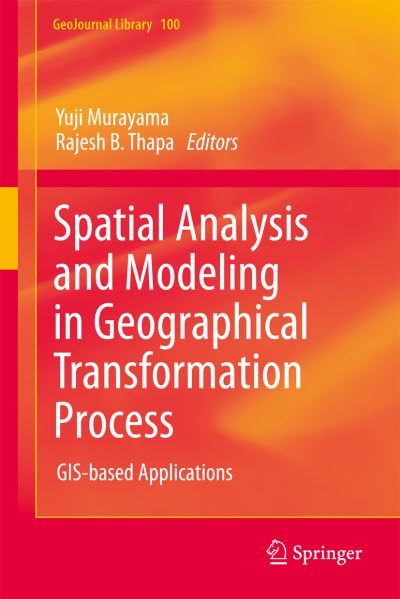
Currently, spatial analysis is becoming more important than ever because enormous volumes of spatial data are available from different sources, such as GPS, Remote Sensing, and others.
This book deals with spatial analysis and modelling. It provides a comprehensive discussion of spatial analysis, methods, and approaches related to human settlements and associated environment. Key contributions with empirical case studies from Iran, Philippines, Vietnam, Thailand, Nepal, and Japan that apply spatial analysis including autocorrelation, fuzzy, voronoi, cellular automata, analytic hierarchy process, artificial neural network, spatial metrics, spatial statistics, regression, and remote sensing mapping techniques are compiled comprehensively.
The core value of this book is a wide variety of results with state of the art discussion including empirical case studies.
It provides a milestone reference to students, researchers, planners, and other practitioners dealing the spatialproblems on urban and regional issues.
We are pleased to announce that this book has been presented with the 2011 publishing award from the GIS Association of Japan.
We would like to congratulate the authors!
| ISBN: | 9789400735460 |
| Publication date: | 21st April 2013 |
| Author: | Yuji Murayama, Rajesh Bahadur Thapa |
| Publisher: | Springer an imprint of Springer Netherlands |
| Format: | Paperback |
| Pagination: | 302 pages |
| Series: | GeoJournal Library |
| Genres: |
Geographical information systems, geodata and remote sensing Sustainability Environmental monitoring Human geography |
Currently, spatial analysis is becoming more important than ever because enormous volumes of spatial data are available from different sources, such as GPS, Remote Sensing, and others.This book deals with spatial analysis and modelling. It provides a comprehensive discussion of spatial analysis, methods, and approaches related to human settlements and associated environment.
Spatial Analysis and Modeling in Geographical Transformation Process features in the following genres: Geographical information systems, geodata and remote sensing, Sustainability, Environmental monitoring, Human geography
Paperback. Not Available.
Spatial Analysis and Modeling in Geographical Transformation Process was written by Yuji Murayama, Rajesh Bahadur Thapa and published by Springer an imprint of Springer Netherlands
Spatial Analysis and Modeling in Geographical Transformation Process has 302 pages
Yes it is part of GeoJournal Library series