

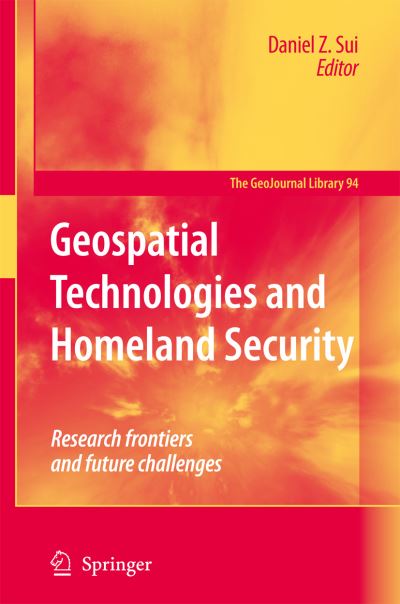
Homeland security and context In the Geographical Dimensions of Terrorism (GDOT) (Cutter et al. 2003), the first book after 9/11 to address homeland security and geography, we developed several thematic research agendas and explored intersections between geographic research and the importance of context, both geographical and political, in relationship to the concepts of terrorism and security. It is good to see that a great deal of new thought and research continues to flow from that initial research agenda, as illustrated by many of the papers of this new book, entitled Geospatial Technologies and Homeland Security: Research Frontiers and Future Challenges.
Context is relevant not only to understanding homeland security issues broadly, but also to the conduct of research on geospatial technologies. It is impossible to understand the implications of a homeland security strategy, let alone hope to make predictions, conduct meaningful modeling and research, or assess the value and dangers of geospatial technologies, without consideration of overarching political, social, economic, and geographic contexts within which these questions are posed.
| ISBN: | 9789048178483 |
| Publication date: | 28th October 2010 |
| Author: | Daniel Sui |
| Publisher: | Springer an imprint of Springer Netherlands |
| Format: | Paperback |
| Pagination: | 360 pages |
| Series: | GeoJournal Library |
| Genres: |
Geographical information systems, geodata and remote sensing Earth sciences |
Homeland security and context In the Geographical Dimensions of Terrorism (GDOT) (Cutter et al. 2003), the first book after 9/11 to address homeland security and geography, we developed several thematic research agendas and explored intersections between geographic research and the importance of context, both geographical and political, in relationship to the concepts of terrorism and security. It is good to see that a great deal of new thought and research continues to flow from that initial research agenda, as illustrated by many of the papers of this new book, entitled Geospatial Technologies and Homeland Security: Research Frontiers and Future Challenges.
Geospatial Technologies and Homeland Security features in the following genres: Geographical information systems, geodata and remote sensing, Earth sciences
Paperback. Not Available.
Geospatial Technologies and Homeland Security was written by Daniel Sui and published by Springer an imprint of Springer Netherlands
Geospatial Technologies and Homeland Security has 360 pages
Yes it is part of GeoJournal Library series