

The advent of the computer age has set in motion a profound shift in our perception of science -its structure, its aims and its evolution. Traditionally, the principal domains of science were, and are, considered to be mathe- matics, physics, chemistry, biology, astronomy and related disciplines. But today, and to an increasing extent, scientific progress is being driven by a quest for machine intelligence - for systems which possess a high MIQ (Machine IQ) and can perform a wide variety of physical and mental tasks with minimal human intervention.
The role model for intelligent systems is the human mind. The influ- ence of the human mind as a role model is clearly visible in the methodolo- gies which have emerged, mainly during the past two decades, for the con- ception, design and utilization of intelligent systems. At the center of these methodologies are fuzzy logic (FL); neurocomputing (NC); evolutionary computing (EC); probabilistic computing (PC); chaotic computing (CC); and machine learning (ML).
Collectively, these methodologies constitute what is called soft computing (SC). In this perspective, soft computing is basically a coalition of methodologies which collectively provide a body of concepts and techniques for automation of reasoning and decision-making in an environment of imprecision, uncertainty and partial truth.
| ISBN: | 9783790825008 |
| Publication date: | 21st October 2010 |
| Author: | Danuta Rutkowska |
| Publisher: | Physica an imprint of Physica-Verlag HD |
| Format: | Paperback |
| Pagination: | 288 pages |
| Series: | Studies in Fuzziness and Soft Computing |
| Genres: |
Artificial intelligence |
The advent of the computer age has set in motion a profound shift in our perception of science -its structure, its aims and its evolution. Traditionally, the principal domains of science were, and are, considered to be mathe- matics, physics, chemistry, biology, astronomy and related disciplines.
Neuro-Fuzzy Architectures and Hybrid Learning features in the following genres: Artificial intelligence
Paperback, Hardback. Not Available.
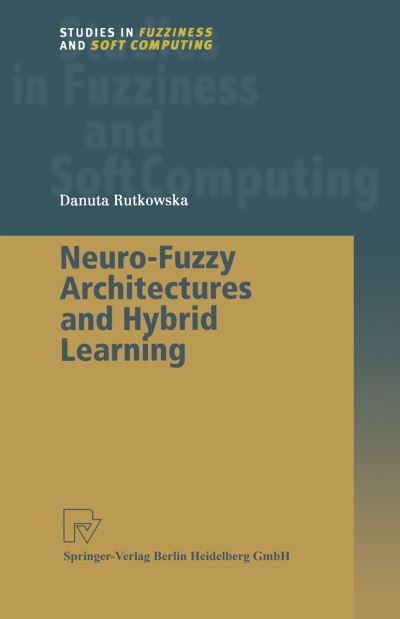
Neuro-Fuzzy Architectures and Hybrid Learning was written by Danuta Rutkowska and published by Physica an imprint of Physica-Verlag HD
Neuro-Fuzzy Architectures and Hybrid Learning has 288 pages
Yes it is part of Studies in Fuzziness and Soft Computing series