

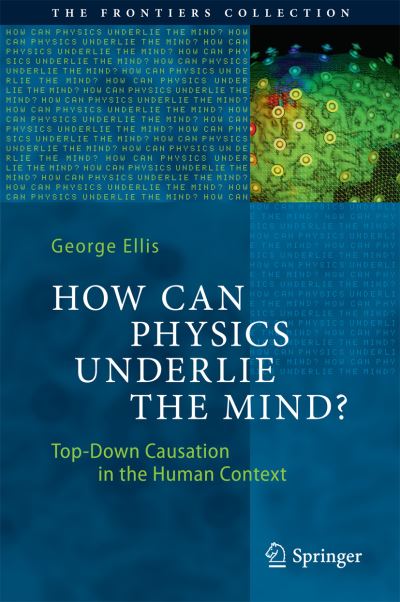
Physics underlies all complexity, including our own existence: how is this possible? How can our own lives emerge from interactions of electrons, protons, and neutrons? This book considers the interaction of physical and non-physical causation in complex systems such as living beings, and in particular in the human brain, relating this to the emergence of higher levels of complexity with real causal powers. In particular it explores the idea of top-down causation, which is the key effect allowing the emergence of true complexity and also enables the causal efficacy of non-physical entities, including the value of money, social conventions, and ethical choices.
| ISBN: | 9783662498071 |
| Publication date: | 9th June 2016 |
| Author: | George Ellis |
| Publisher: | Springer an imprint of Springer Berlin Heidelberg |
| Format: | Hardback |
| Pagination: | 482 pages |
| Series: | The Frontiers Collection |
| Genres: |
Cybernetics and systems theory Evolution Neurosciences Philosophy: epistemology and theory of knowledge Mathematical physics |
Physics underlies all complexity, including our own existence: how is this possible? How can our own lives emerge from interactions of electrons, protons, and neutrons?
How Can Physics Underlie the Mind? features in the following genres: Cybernetics and systems theory, Evolution, Neurosciences, Philosophy: epistemology and theory of knowledge, Mathematical physics
Hardback. Not Available.
How Can Physics Underlie the Mind? was written by George Ellis and published by Springer an imprint of Springer Berlin Heidelberg
How Can Physics Underlie the Mind? has 482 pages
Yes it is part of The Frontiers Collection series