

With the recent great expansion in optics and laser applications, several new areas of research have emerged, among which are: the theory of coherence, photon statistics, speckle phenomenon, statistical optics, atmospheric propa- gation, optical communications, and light-beating and photon-correlation spectroscopy. A factor common to these overlapping subjects is their basic dependence on the treatment of light as a randomly fluctuating excitation.
Moreover, they all necessitate a thorough understanding of the phenomenon of light detection and the additional randomness it introduces. My objective in writing this book is to provide a unified and general presentation of a basic theoretical background central to these areas. This book has a threefold purpose: to present a systematic treatment of the statistical properties of optical fields, to develop methods for deter- mining the statistics of the photoelectron events that are generated when such fields are intercepted by photodetectors, and to examine methods of estimating unknown field parameters from measurements of the photoelectron events.
Emphasis is placed on the photoelectron measurements that yield in- formation pertinent to spectroscopy and optical communication. Although some books that treat the theory of coherence and the statisti- cal properties of light are available, the vast body of information central to problems of photoelectron statistics and its applications is scattered in various professional journals and conference proceedings.
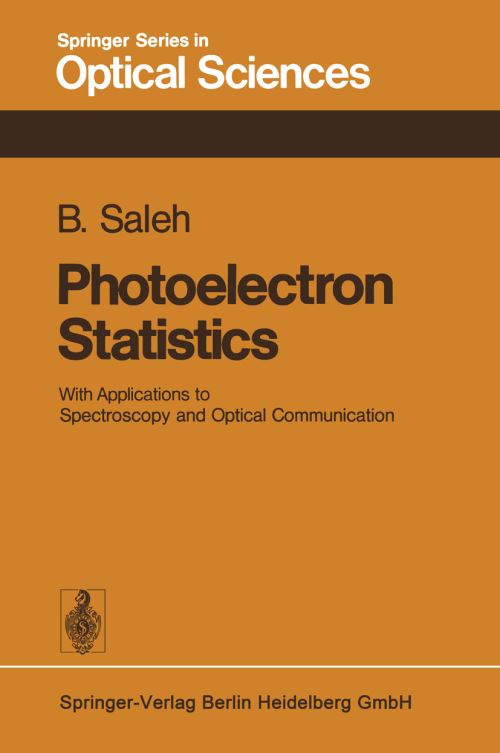
| ISBN: | 9783662134832 |
| Publication date: | 20th November 2013 |
| Author: | B Saleh |
| Publisher: | Springer an imprint of Springer Berlin Heidelberg |
| Format: | Paperback |
| Pagination: | 444 pages |
| Series: | Springer Series in Optical Sciences |
| Genres: |
Laser physics |
With the recent great expansion in optics and laser applications, several new areas of research have emerged, among which are: the theory of coherence, photon statistics, speckle phenomenon, statistical optics, atmospheric propa- gation, optical communications, and light-beating and photon-correlation spectroscopy. A factor common to these overlapping subjects is their basic dependence on the treatment of light as a randomly fluctuating excitation.
Photoelectron Statistics features in the following genres: Laser physics
Paperback. Not Available.
Photoelectron Statistics was written by B Saleh and published by Springer an imprint of Springer Berlin Heidelberg
Photoelectron Statistics has 444 pages
Yes it is part of Springer Series in Optical Sciences series