

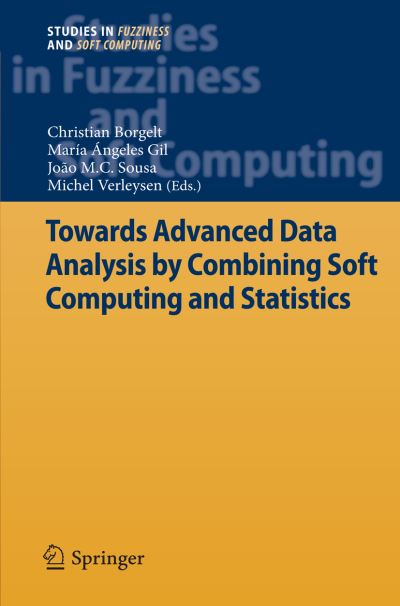
Soft computing, as an engineering science, and statistics, as a classical branch of mathematics, emphasize different aspects of data analysis.
Soft computing focuses on obtaining working solutions quickly, accepting approximations and unconventional approaches. Its strength lies in its flexibility to create models that suit the needs arising in applications.
In addition, it emphasizes the need for intuitive and interpretable models, which are tolerant to imprecision and uncertainty.
Statistics is more rigorous and focuses on establishing objective conclusions based on experimental data by analyzing the possible situations and their (relative) likelihood.
It emphasizes the need for mathematical methods and tools to assess solutions and guarantee performance.
Combining the two fields enhances the robustness and generalizability of data analysis methods, while preserving the flexibility to solve real-world problems efficiently and intuitively.
| ISBN: | 9783642302770 |
| Publication date: | 29th August 2012 |
| Author: | Christian Borgelt |
| Publisher: | Springer an imprint of Springer Berlin Heidelberg |
| Format: | Hardback |
| Pagination: | 378 pages |
| Series: | Studies in Fuzziness and Soft Computing |
| Genres: |
Artificial intelligence Expert systems / knowledge-based systems Maths for computer scientists Computer modelling and simulation Probability and statistics Data mining |
Soft computing, as an engineering science, and statistics, as a classical branch of mathematics, emphasize different aspects of data analysis.Soft computing focuses on obtaining working solutions quickly, accepting approximations and unconventional approaches. Its strength lies in its flexibility to create models that suit the needs arising in applications.
Towards Advanced Data Analysis by Combining Soft Computing and Statistics features in the following genres: Artificial intelligence, Expert systems / knowledge-based systems, Maths for computer scientists, Computer modelling and simulation, Probability and statistics, Data mining
Hardback. Not Available.
Towards Advanced Data Analysis by Combining Soft Computing and Statistics was written by Christian Borgelt and published by Springer an imprint of Springer Berlin Heidelberg
Towards Advanced Data Analysis by Combining Soft Computing and Statistics has 378 pages
Yes it is part of Studies in Fuzziness and Soft Computing series