

Almosttwodecadeshavepassedsincetheappearanceofthosegrapht- ory texts that still set the agenda for most introductory courses taught today. The canon created by those books has helped to identify some main?eldsofstudyandresearch,andwilldoubtlesscontinuetoin?uence the development of the discipline for some time to come. Yet much has happened in those 20 years, in graph theory no less thanelsewhere: deepnewtheoremshavebeenfound,seeminglydisparate methods and results have become interrelated, entire new branches have arisen.
To name just a few such developments, one may think of how the new notion of list colouring has bridged the gulf between inva- ants such as average degree and chromatic number, how probabilistic methods andtheregularity lemmahave pervadedextremalgraphtheory and Ramsey theory, or how the entirely new ?eld of graph minors and tree-decompositions has brought standard methods of surface topology to bear on long-standing algorithmic graph problems.
Clearly, then, the time has come for a reappraisal: what are, today, the essential areas, methods and results that should form the centre of an introductory graph theory course aiming to equip its audience for the most likely developments ahead? I have tried in this book to o?er material for such a course. In view of the increasing complexity and maturity of the subject, I have broken with the tradition of attempting to cover both theory and app- cations: this book o?ers an introduction to the theory of graphs as part of (pure) mathematics; it contains neither explicit algorithms nor 'real world' applications.
| ISBN: | 9783642142789 |
| Publication date: | 19th July 2010 |
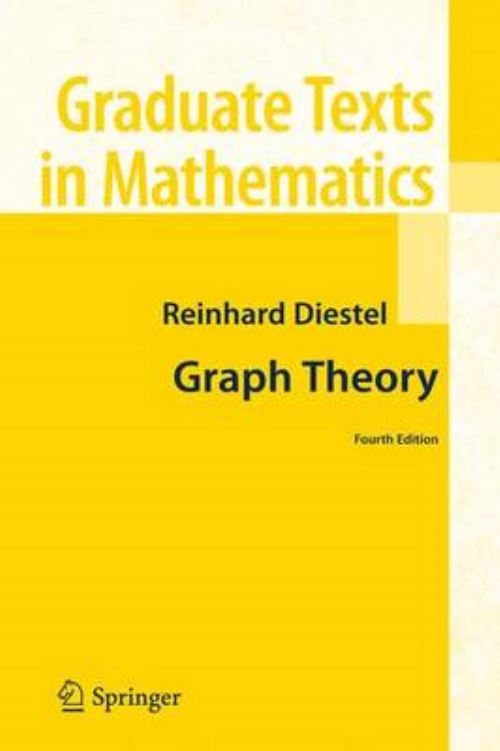
| Author: | Reinhard Diestel |
| Publisher: | Springer an imprint of Springer Berlin Heidelberg |
| Format: | Paperback |
| Pagination: | 436 pages |
| Series: | Graduate Texts in Mathematics |
| Genres: |
Combinatorics and graph theory Maths for computer scientists |
Almosttwodecadeshavepassedsincetheappearanceofthosegrapht- ory texts that still set the agenda for most introductory courses taught today. The canon created by those books has helped to identify some main?eldsofstudyandresearch,andwilldoubtlesscontinuetoin?uence the development of the discipline for some time to come.
Graph Theory features in the following genres: Combinatorics and graph theory, Maths for computer scientists
Hardback, Paperback. Not Available.
Graph Theory was written by Reinhard Diestel and published by Springer an imprint of Springer Berlin Heidelberg
Graph Theory has 436 pages
Yes it is part of Graduate Texts in Mathematics series