

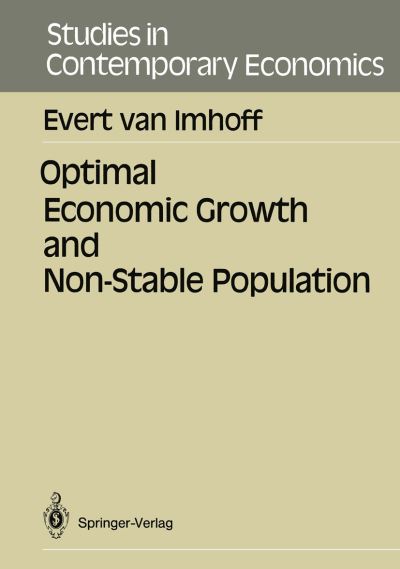
This book studies optimal economic growth in a closed economy which experiences non-stable population growth. The economy is described by means of a neoclassical growth model which distinguishes overlapping generations within the population. The basic neoclassical growth model is extended to include various types of technical change, as well as investment in human capital or education.
The research described in this book connects the analytical tools of traditional growth theory with the actual demographic experience of most industrialized countries. The role of demographic processes in the growth- theoretical literature is discussed in the next section. The discussion will show that growth theory needs to extend its scope through the construction of growth models which explicitly recognize demographic forces as a potential source of non-stationarities.
This book constitutes a first attempt at such a demographic extension. 1.1 Growth theory and demographic change The theory of economic growth (e.g. Solow, 1970; Burmeister & Dobell, 1970; Wan, 1971) attempts to describe and to explain the long-run development of an economic system (or, in short, economy). An economic system is essentially dynamic in nature.
Among the most important sources of dynamics in economics are the following:
| ISBN: | 9783540515562 |
| Publication date: | 18th October 1989 |
| Author: | Evert van Imhoff |
| Publisher: | Springer an imprint of Springer Berlin Heidelberg |
| Format: | Paperback |
| Pagination: | 219 pages |
| Series: | Studies in Contemporary Economics |
| Genres: |
Population and demography |
This book studies optimal economic growth in a closed economy which experiences non-stable population growth. The economy is described by means of a neoclassical growth model which distinguishes overlapping generations within the population.
Optimal Economic Growth and Non-Stable Population features in the following genres: Population and demography
Paperback. Not Available.
Optimal Economic Growth and Non-Stable Population was written by Evert van Imhoff and published by Springer an imprint of Springer Berlin Heidelberg
Optimal Economic Growth and Non-Stable Population has 219 pages
Yes it is part of Studies in Contemporary Economics series