

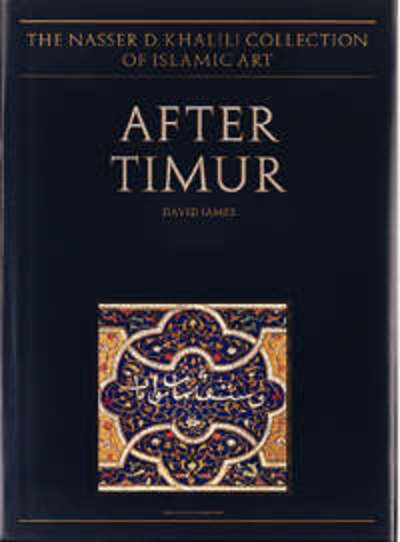
The Nasser D. Khalili Collection contains the largest range of Qur'anic material in private hands and includes examples from centres as far apart as Spain and India. The third of four volumes dedicated to the Qur'ans in the collection, this work covers the period from AD 1400 to AD 1600.
The Khalili Collection is the greatest collection of Islamic art in private hands; it is continuing to grow and improve. It contains a large and comprehensive range of Qur'anic material, covering the entire history of Qur'an production from the seventh to the twentieth century, including examples from centres as far apart as Spain and India. This is the third of four volumes cataloguing the Qur'ans in the Khalili Collection.
It includes fifteenth century Qur'ans in Iran, Egypt, Syria, Constantinople, and India; sixteenth century Qur'ans in Iran and India. The lavish presentation of this catalogue is combined with detailed scholarship that not only encompasses the history of the subject, but also presents in accompanying essays new findings that have been made in the course of cataloguing.;The text is supported by notes, up-to-date bibliography, and index, while inscriptions are reproduced in their original languages, with English translations.
Dr James is an internationally renowned authority on Arab and Persian manuscripts, and on Qur'ans in particular. This book is intended for art historians, Islamicists, collectors and curators of Islamic art.
| ISBN: | 9781874780533 |
| Publication date: | 1st December 1992 |
| Author: | David James |
| Publisher: | Khalili Collections |
| Format: | Hardback |
| Pagination: | 256 pages |
| Series: | The Nasser D. Khalili Collection of Islamic Art |
| Genres: |
The Arts Architecture Islam Social groups: religious groups and communities |
The Nasser D. Khalili Collection contains the largest range of Qur'anic material in private hands and includes examples from centres as far apart as Spain and India.
After Timur features in the following genres: The Arts, Architecture, Islam, Social groups: religious groups and communities
Hardback. Not Available.
After Timur was written by David James and published by Khalili Collections
After Timur has 256 pages
Yes it is part of The Nasser D. Khalili Collection of Islamic Art series