

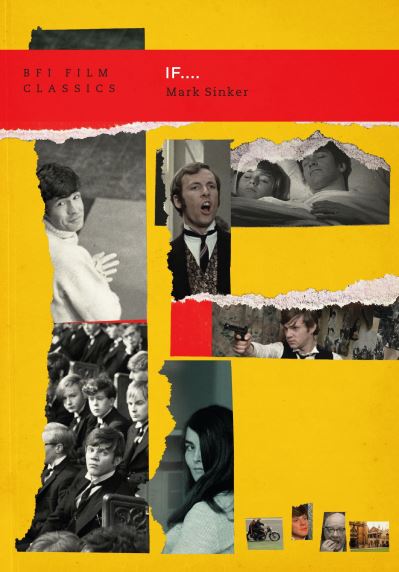
In his compelling study of if.... (1968), starring which stars Malcolm McDowell as an English public school student who leads a guerrilla insurgence, Mark Sinker traces director Lindsay Anderson's depiction of the progress from repression, conformity and fusty ritual to anarchy and bloody revolt. The film's title is a sardonic nod to Rudyard Kipling's most famous poem, while its narrative explores how prankish rebels are groomed to police an Empire. Released at a time of unprecedented student uprisings in Europe and America, if.... provided a peculiarly English perspective on the battle between generations - the perennial war of the romantically passionate against the corrupt, the ugly, the old, and the foolish. Though its emotional surface is authentically anti-authoritarian, its intellectual substance, as Sinker argues, is rooted in a deep familiarity with the symbols of English ruling-class values.
In his foreword for this new edition, Mark Sinker considers if.... 's continuing relevance in respect of two contemporary phenomena (the ghastly commonplace of school shootings; urban terrorism) including the degree to which we somehow continue to feel sympathy toward this small gang of entitled schoolboys. Contemplating director Anderson's ambivalence towards education, not least the jargons of academic film theory after the 1960s, Sinker reflects on how his own approach to the film was informed by the critical lingua franca of the 1980s music press.
| ISBN: | 9781839029929 |
| Publication date: | 19th February 2026 |
| Author: | Mark Sinker |
| Publisher: | BFI an imprint of Bloomsbury Publishing (UK) |
| Format: | Paperback |
| Pagination: | 112 pages |
| Series: | BFI Film Classics |
| Genres: |
Films, cinema Film guides and reviews Film: styles and genres |
In his compelling study of if.... (1968), starring which stars Malcolm McDowell as an English public school student who leads a guerrilla insurgence, Mark Sinker traces director Lindsay Anderson's depiction of the progress from repression, conformity and fusty ritual to anarchy and bloody revolt. The film's title is a sardonic nod to Rudyard Kipling's most famous poem, while its narrative explores how prankish rebels are groomed to police an Empire.
If.... features in the following genres: Films, cinema, Film guides and reviews, Film: styles and genres
Paperback. £11.69, down from the £12.99 cover price. Not Available.
If.... was written by Mark Sinker and published by BFI an imprint of Bloomsbury Publishing (UK)
If.... has 112 pages
Yes it is part of BFI Film Classics series
£11.69, reduced from £12.99. Not Available.