

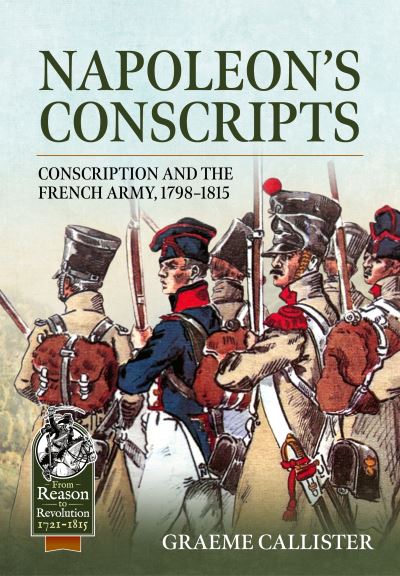
The Grande Armée is remembered as a force of hardened veterans. Yet as early as his famous victory at Austerlitz in 1805, Napoleon's army was overwhelmingly a conscript force. By Waterloo in 1815, even many of the Imperial Guardsmen who marched in the fated final attack had begun their military careers as conscripts. Between 1798 and Napoleon's first abdication in 1814, perhaps 2.4 million men were conscripted into the French armed forces. Their story is inseparable from that of Napoleon's wars.
In Napoleon's Conscripts, Graeme Callister follows these men from registration and the fateful conscription ballot through departure, depot and training, regimental life, campaign and battle, to desertion, discharge, captivity or death. He explains who was called, who escaped through exemption or replacement, why others resisted, and how the Napoleonic state employed bureaucracy, policing and ultimately force to secure the manpower demanded by almost continual war.
Structured around the conscript's journey from civilian life into the ranks, the book first reconstructs the machinery of selection: the ballot, exemptions, substitutions and the administrative process that determined who would serve. It then follows the men themselves as they left their homes, marched to regimental depots, underwent training, adapted to army culture and experienced campaigning and combat. Later chapters examine the ways in which service ended - through death, desertion, discharge or captivity - before turning to the wider consequences of conscription for the French army, popular resistance to the draft, and the increasingly powerful machinery of policing and coercion used to enforce it.
Drawing on extensive archival research and the original service records of tens of thousands of soldiers, Callister challenges familiar assumptions about Napoleonic conscripts as unwilling, barely trained youths. Many became experienced soldiers, non-commissioned officers, officers and guardsmen; others deserted, died from disease or returned home physically broken by their service. Their experiences illuminate not only life inside Napoleon's army, but the profound impact of conscription on families, communities and the relationship between the French people and the state.
These were the men who marched into Vienna, Berlin, Madrid and Moscow; who won at Austerlitz, Friedland and Wagram; and who suffered defeat at Aspern-Essling, Leipzig and Waterloo. They were, quite simply, at the heart of Napoleon's military story.
| ISBN: | 9781804516751 |
| Publication date: | 26th September 2026 |
| Author: | Graeme Callister |
| Publisher: | Helion & Company an imprint of Helion and Company |
| Format: | Hardback |
| Pagination: | 184 pages |
| Series: | From Reason to Revolution 1721-1815 |
| Genres: |
Specific wars and campaigns |
The Grande Armée is remembered as a force of hardened veterans. Yet as early as his famous victory at Austerlitz in 1805, Napoleon's army was overwhelmingly a conscript force.
Napoleon's Conscripts features in the following genres: Specific wars and campaigns
Hardback. £26.96, down from the £29.95 cover price. Not Available.
Napoleon's Conscripts was written by Graeme Callister and published by Helion & Company an imprint of Helion and Company
Napoleon's Conscripts has 184 pages
Yes it is part of From Reason to Revolution 1721-1815 series
£26.96, reduced from £29.95. Not Available.