

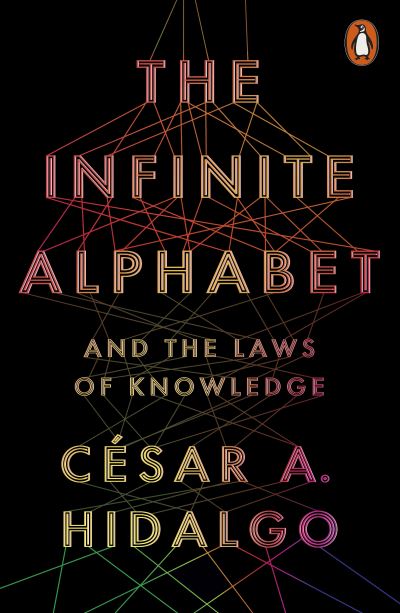
We all understand that knowledge shapes the fate of business and the growth of nations, but few of us are aware of the principles that govern its motion. The Infinite Alphabet unravels the laws describing the growth and diffusion of knowledge by taking you from a failed attempt to build a city of knowledge in Ecuador to the growth of China's innovation economy. Through dozens of stories, you will learn why aircraft manufacturers in Italy began manufacturing scooters after the Second World War and how migrants like Samuel Slater shaped the industrial fabric of the United States.
Knowledge is the secret to the wealth of nations. But to understand it, we must accept that it is not a single thing, but an ever-growing tapestry of unique ideas, experiences and received wisdom. An Infinite Alphabet that we are only beginning to fathom.
César A. Hidalgo, a world-renowned scholar for his work on economic complexity, will walk you through the "three laws" and the many principles that govern how knowledge grows, moves, and decays. By the end of this journey, you will understand why knowledge grows exponentially in the electronics industry and what mechanisms govern its diffusion across geographic borders, social networks, and professional boundaries.
Together these principles will teach you how knowledge shapes the world.
| ISBN: | 9781802063776 |
| Publication date: | 5th November 2026 |
| Author: | César A Hidalgo |
| Publisher: | Penguin Books an imprint of Penguin Books Ltd |
| Format: | Paperback |
| Pagination: | 256 pages |
| Genres: |
Popular economics Knowledge / Information / Data economics Impact of science and technology on society Popular Science Philosophy of language Economic theory and philosophy |
We all understand that knowledge shapes the fate of business and the growth of nations, but few of us are aware of the principles that govern its motion. The Infinite Alphabet unravels the laws describing the growth and diffusion of knowledge by taking you from a failed attempt to build a city of knowledge in Ecuador to the growth of China's innovation economy.
The Infinite Alphabet features in the following genres: Popular economics, Knowledge / Information / Data economics, Impact of science and technology on society, Popular Science, Philosophy of language, Economic theory and philosophy
Paperback, Hardback. £11.69, down from the £12.99 cover price. In Stock.
The Infinite Alphabet was written by César A Hidalgo and published by Penguin Books an imprint of Penguin Books Ltd
The Infinite Alphabet has 256 pages
£11.69, reduced from £12.99. In Stock.