

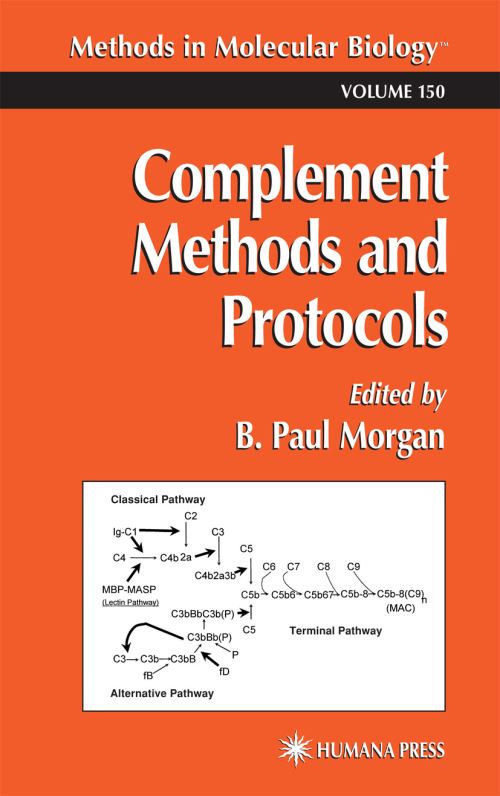
The complement system, first described more than a century ago, was for many years the ugly duckling of the immunology world, but no more. Complement in recent years has blossomed into a fascinating and fast moving field of immediate relevance to clinical scientists in fields as diverse as transplantation biology, virology, and inflammation. Despite its emergence from the shadows, complement retains an unwarranted reputation for being "difficult." This impression derives in large part from the superficially complicated nomenclature, a relic of the long and tortuous process of unraveling the system, of naming components in order of discovery rather than in a syst- atic manner.
Once the barrier of nomenclature has been surmounted, then the true simplicity of the system becomes apparent. Complement comprises an activation system and a cytolytic system. The former has diverged to focus on complement to distinct targets-bacteria, - mune complexes, and others-so that texts now describe three activation pa- ways, closely related to one another, but each with some unique features.
The cytolytic pathway is the same regardless of the activation process and kills cells by creating pores in the membrane. Complement plays an important role in killing bacteria and is essential for the proper handling of immune complexes. Problems occur when complement is activated in an inappropriate manner-the potent inflammation-inducing products of the cascade then cause unwanted tissue damage and destruction.
| ISBN: | 9781617371165 |
| Publication date: | 10th November 2010 |
| Author: | B Paul Morgan |
| Publisher: | Humana Press |
| Format: | Paperback |
| Pagination: | 259 pages |
| Series: | Methods in Molecular Biology |
| Genres: |
Immunology |
The complement system, first described more than a century ago, was for many years the ugly duckling of the immunology world, but no more. Complement in recent years has blossomed into a fascinating and fast moving field of immediate relevance to clinical scientists in fields as diverse as transplantation biology, virology, and inflammation.
Complement Methods and Protocols features in the following genres: Immunology
Paperback, Hardback. Not Available.
Complement Methods and Protocols was written by B Paul Morgan and published by Humana Press
Complement Methods and Protocols has 259 pages
Yes it is part of Methods in Molecular Biology series