

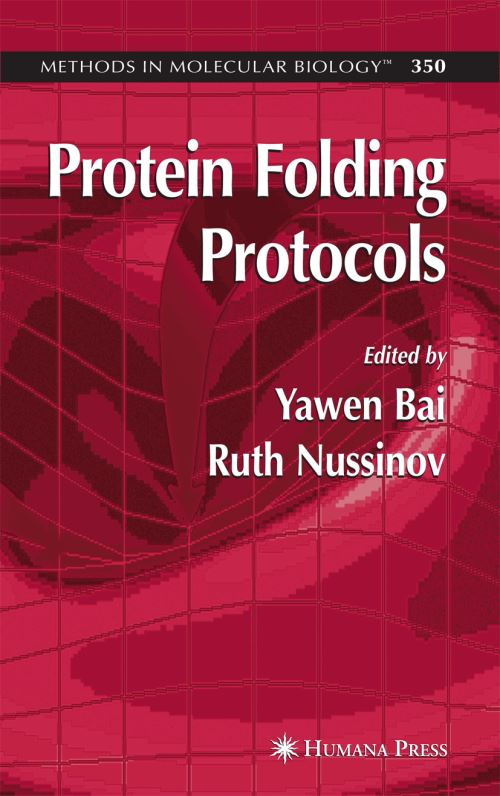
Protein Folding Protocols presents protocols for studying and characterizing steps and conformational ensembles populating pathways in protein folding from the unfolded to the folded state. It further presents a sample of approaches toward the prediction of protein structure starting from the amino acid sequence, in the absence of overall homologous sequences. Protein folding is a crucial step in the transfer of genetic information from the DNA to the protein.
The Genome Project has led to a huge number of available DNA sequences and, therefore, protein sequences. The Structural Genomics initiative largely aims to obtain "new" folds not currently present in the Protein Data Bank. Yet, the number of available structures inevitably lags behind the number of sequences.
At the same time, an equally important problem is to find out the types and scope of dissimilar (nonhomologous) protein sequences that adopt a similar fold. Assembling data and comprehension of the sequence space of protein folds should be very useful in computational protein structure prediction. This would enhance the scope of homology modeling, which currently is the method of choice.
Thus, experimental and theoretical studies on the relationship between sequence and structure are critical. Figuring out the relationship between sequence and structure would further assist in the prediction of fibril structures observed in protein misfolding diseases, and in figuring out the conformational changes and dynamics resulting from mutations. Protein folding is one of the most important and challenging problems in current molecular and chemical biology.
| ISBN: | 9781588296221 |
| Publication date: | 24th July 2006 |
| Author: | Yawen Bai, Ruth Nussinov |
| Publisher: | Humana Press |
| Format: | Hardback |
| Pagination: | 327 pages |
| Series: | Methods in Molecular Biology |
| Genres: |
Cellular biology (cytology) |
Protein Folding Protocols presents protocols for studying and characterizing steps and conformational ensembles populating pathways in protein folding from the unfolded to the folded state. It further presents a sample of approaches toward the prediction of protein structure starting from the amino acid sequence, in the absence of overall homologous sequences.
Protein Folding Protocols features in the following genres: Cellular biology (cytology)
Hardback. Not Available.
Protein Folding Protocols was written by Yawen Bai, Ruth Nussinov and published by Humana Press
Protein Folding Protocols has 327 pages
Yes it is part of Methods in Molecular Biology series