

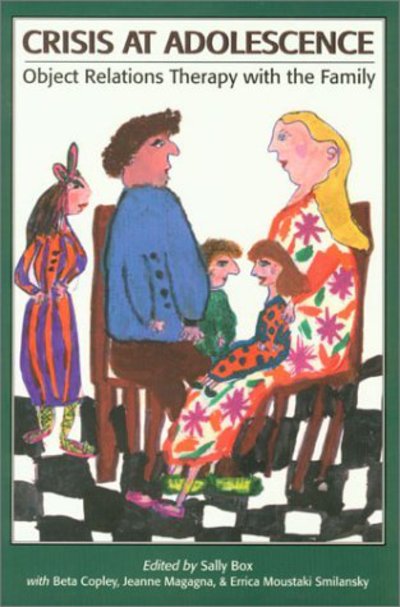
This book is about work with adolescents and their families. It is based on a particular psychoanalytic understanding of the way people function and grow and on the development of a corresponding family therapy model. It includes throughout detailed examples to illustrate the interactions between therapists and family members together with the concepts used to understand and work with them. This volume presents an approach therapists can learn in order to make the most of their capacity to be in touch with their own and others' feelings as a major tool in the therapeutic work with families. Adolescence is viewed as epitomizing a transitional time when hard-won patterns of stability in the family - individually and as a group - are liable to break down. Hitherto denied and split-off feelings threaten to erupt and may cause disturbing changes of attitude and behavior. There is the danger of severe fragmentation but at the same time a chance to reintegrate the unmanageable aspects rather than deal with them via projection and acting out. However, the only way this can happen is if those split-off feelings and functions can be contained and integrated at a feeling level as well as at a verbal level. The authors describe a method that helps the family as a whole and as individuals to come to grips with the processes that are causing trouble, and to discover or rediscover previously disowned aspects of themselves. In this approach therapists represent and carry the functions and painful feelings that cannot otherwise be borne, such as madness, inadequacy or rejection, toward the possibility of their being made bearable and reintegrated. The model draws heavily on the concepts of Melanie Klein and her successors - particularly that of projective identification, the notion of the paranoid-schizoid and depressive positions, the work on narcissism and borderline states, and especially Bion's contributions to the processes of thinking and 'containment.'
| ISBN: | 9781568210940 |
| Publication date: | 7th July 1977 |
| Author: | Sally Box |
| Publisher: | Jason Aronson an imprint of Jason Aronson, Inc. |
| Format: | Hardback |
| Pagination: | 275 pages |
| Series: | The Library of Object Relations |
| Genres: |
Age groups: adolescents Sociology: family and relationships Psychiatry Psychotherapy |
This book is about work with adolescents and their families. It is based on a particular psychoanalytic understanding of the way people function and grow and on the development of a corresponding family therapy model. It includes throughout detailed examples to illustrate the interactions between therapists and family members together with the concepts used to understand and work with them. This volume presents an approach therapists can learn in order to make the most of their capacity to be in touch with their own and others' feelings as a major tool in the therapeutic work with families. Adolescence is viewed as epitomizing a transitional time when hard-won patterns of stability in the family - individually and as a group - are liable to break down. Hitherto denied and split-off feelings threaten to erupt and may cause disturbing changes of attitude and behavior. There is the danger of severe fragmentation but at the same time a chance to reintegrate the unmanageable aspects rather than deal with them via projection and acting out. However, the only way this can happen is if those split-off feelings and functions can be contained and integrated at a feeling level as well as at a verbal level. The authors describe a method that helps the family as a whole and as individuals to come to grips with the processes that are causing trouble, and to discover or rediscover previously disowned aspects of themselves. In this approach therapists represent and carry the functions and painful feelings that cannot otherwise be borne, such as madness, inadequacy or rejection, toward the possibility of their being made bearable and reintegrated. The model draws heavily on the concepts of Melanie Klein and her successors - particularly that of projective identification, the notion of the paranoid-schizoid and depressive positions, the work on narcissism and borderline states, and especially Bion's contributions to the processes of thinking and 'containment.'
Crisis at Adolescence features in the following genres: Age groups: adolescents, Sociology: family and relationships, Psychiatry, Psychotherapy
Crisis at Adolescence is available in Hardback
Crisis at Adolescence was written by Sally Box and published by Jason Aronson an imprint of Jason Aronson, Inc.
Crisis at Adolescence has 275 pages
Yes it is part of The Library of Object Relations series