

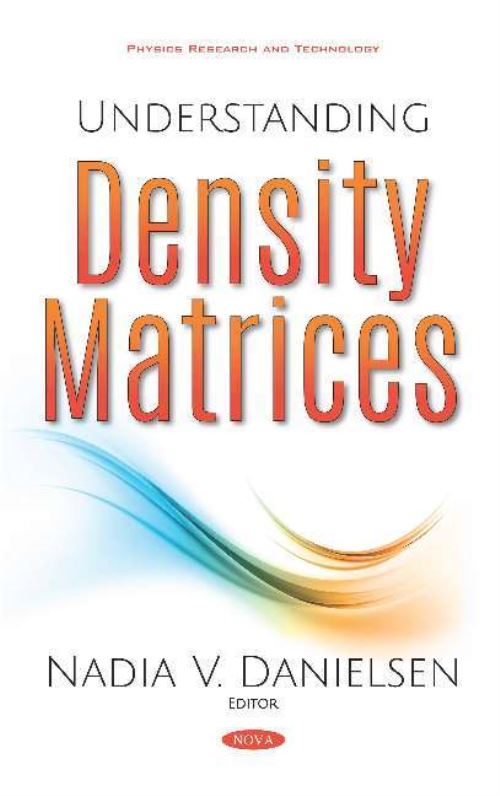
In Understanding Density Matrices, the modulus and phase degrees-of-freedom of molecular states are examined, the relevant continuity relations are identified, and corresponding contributions to the resultant gradient information are summarized. The geometric and physical factors in contributions to the overall gradient information content in a quantum state are also identified. Following this, a formalism is presented for the one- and two-body density matrices in coordinate space and their Fourier transforms in momentum space of a non-relativistic, self-bound, finite-size quantum system.
The formalism is applied to atomic nuclei with a focus on nucleon momentum distributions which reveal important information on short-range correlations. Next, the authors investigate the problem of preparing a target initial state for a two-level system from a system-environment equilibrium or correlated state by an external field. By using the time evolutions of the population difference, the state trajectory in the Bloch sphere representation, and the trace distance between two reduced system states of the open quantum system, the effect of initial system-environment correlations on the preparation of a system state is studied.
The authors also study the role of the density matrix in a cryptographic problem called quantum bit commitment, and show how it can be used as a clue for finding secure quantum bit commitment protocols. In subsequent chapter, optical bistability in ladder-plus-Y double quantum dot structure in a unidirectional ring-cavity was modeled using the density matrix theory in parallel with the momentum matrix elements of each transition, which was used to specify Rabi frequencies.
Additionally, the phase transition temperatures of the two-dimensional lattice gas of the basal and prism planes of the wurtzite crystal structure were explored using the density-matrix renormalization-group method. In the closing chapter, the mathematical methods of the description of the evolution of states of quantum many-particle systems by means of the possible modifications of the density operator are considered.
| ISBN: | 9781536162455 |
| Publication date: | 10th October 2019 |
| Author: | Nadia V Danielsen |
| Publisher: | Nova Science Publishers an imprint of Nova Science Publishers, Inc |
| Format: | Hardback |
| Pagination: | 268 pages |
| Series: | Physics Research and Technology |
| Genres: |
Physics Mathematical physics |
In Understanding Density Matrices, the modulus and phase degrees-of-freedom of molecular states are examined, the relevant continuity relations are identified, and corresponding contributions to the resultant gradient information are summarized. The geometric and physical factors in contributions to the overall gradient information content in a quantum state are also identified.
Understanding Density Matrices features in the following genres: Physics, Mathematical physics
Hardback. Not Available.
Understanding Density Matrices was written by Nadia V Danielsen and published by Nova Science Publishers an imprint of Nova Science Publishers, Inc
Understanding Density Matrices has 268 pages
Yes it is part of Physics Research and Technology series