

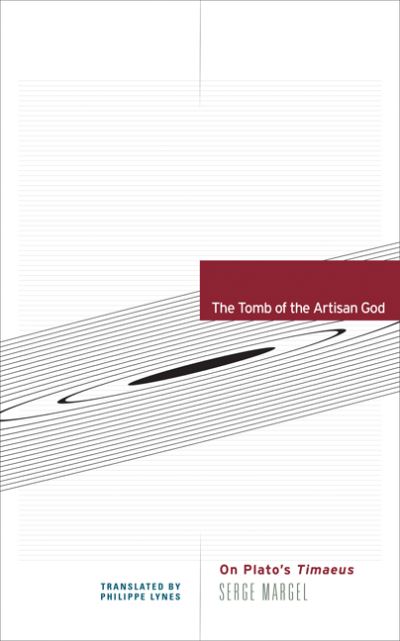
A far-reaching reinterpretation of Plato's Timaeus and its engagement with time, eternity, body, and soul that in its original French edition profoundly influenced Derrida
The Tomb of the Artisan God provides a radical rereading of Timaeus, Plato's metaphysical text on time, eternity, and the relationship between soul and body. First published in French in 1995, the original edition of Serge Margel's book included an extensive introductory essay by Jacques Derrida, who drew on Margel's insights in developing his own concepts of time, the promise, the world, and khora. Now available in English with a new preface by Margel, this engagement with Platonic thought proceeds from two questions that span the history of philosophy: What is time? What is the body?
Margel's twinned interrogation centers around Plato's concept of the demiurge (divine artisan or craftsman): its body, its anthropomorphic attributes, its productive capacities and regulatory functions in the ordering/organization/assembling of the world. He posits that this paradoxical figure is not merely a cosmological metaphor for the living body but also the site of its destruction, dissolution, and disappearance. Torn between the finite and the infinite, being and becoming, the concept of demiurge also poses metaphysical questions about time, time before time, and the end of time. The ontological status of the demiurge's body, Margel argues, would become increasingly decisive in the history of philosophy, particularly in Christianity and the dogma of incarnation.
| ISBN: | 9781517906429 |
| Publication date: | 22nd January 2019 |
| Author: | Serge Margel |
| Publisher: | University of Minnesota Press an imprint of University Of Minnesota Press |
| Format: | Paperback |
| Pagination: | 184 pages |
| Series: | Univocal |
| Genres: |
Philosophical traditions and schools of thought Western philosophy from c 1800 |
A far-reaching reinterpretation of Plato's Timaeus and its engagement with time, eternity, body, and soul that in its original French edition profoundly influenced Derrida
The Tomb of the Artisan God provides a radical rereading of Timaeus, Plato's metaphysical text on time, eternity, and the relationship between soul and body. First published in French in 1995, the original edition of Serge Margel's book included an extensive introductory essay by Jacques Derrida, who drew on Margel's insights in developing his own concepts of time, the promise, the world, and khora. Now available in English with a new preface by Margel, this engagement with Platonic thought proceeds from two questions that span the history of philosophy: What is time? What is the body?
Margel's twinned interrogation centers around Plato's concept of the demiurge (divine artisan or craftsman): its body, its anthropomorphic attributes, its productive capacities and regulatory functions in the ordering/organization/assembling of the world. He posits that this paradoxical figure is not merely a cosmological metaphor for the living body but also the site of its destruction, dissolution, and disappearance. Torn between the finite and the infinite, being and becoming, the concept of demiurge also poses metaphysical questions about time, time before time, and the end of time. The ontological status of the demiurge's body, Margel argues, would become increasingly decisive in the history of philosophy, particularly in Christianity and the dogma of incarnation.
The Tomb of the Artisan God features in the following genres: Philosophical traditions and schools of thought, Western philosophy from c 1800
The Tomb of the Artisan God is available in Paperback
The Tomb of the Artisan God was written by Serge Margel and published by University of Minnesota Press an imprint of University Of Minnesota Press
The Tomb of the Artisan God has 184 pages
Yes it is part of Univocal series