

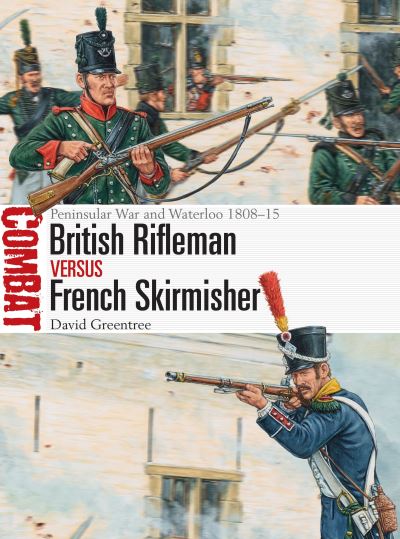
The battles between British and French forces during the Peninsular War (1807-14) and the Hundred Days campaign of 1815 saw both sides deploy specialist units of skirmishers trained in marksmanship and open-order combat.
These 'light' troops fulfilled several important roles on the battlefield, such as 'masking' large bodies of close-order troops as they manoeuvred in battle, firing upon enemy troops to provoke them into attacking prematurely, and harassing enemy artillery crews and senior officers with aimed fire. On occasion, the skirmishers were tasked with special missions requiring individual initiative, such as the capture or defence of key battlefield positions, especially those situated in difficult terrain.
While Napoleon's skirmishers carried the smoothbore musket, notoriously inaccurate and short-ranged, several elite units fighting for Britain were armed with the rifle, a far more accurate weapon that was hampered by a slower rate of fire. As well as the legendary 95th Rifles, Britain fielded rifle-armed German troops of the 60th Regiment and the King's German Legion, while France's light troops were fielded in individual companies but also entire regiments.
In this study, David Greentree assesses the role and effectiveness of rifle-armed British troops and their French open-order opponents in three very different encounters: Roliça (August 1808), the first British battle of the Peninsular War; the struggle for a key bridge at Barba del Puerco (March 1810); and the bitter fight for the La Haye Sainte farmhouse during the battle of Waterloo (June 1815).
| ISBN: | 9781472831842 |
| Publication date: | 20th February 2020 |
| Author: | David Greentree |
| Illustrator: | Adam Hook |
| Publisher: | Osprey Publishing an imprint of Bloomsbury Publishing (UK) |
| Format: | Paperback |
| Pagination: | 80 pages |
| Series: | Combat |
| Genres: |
Military history Land forces and warfare European history |
The battles between British and French forces during the Peninsular War (1807-14) and the Hundred Days campaign of 1815 saw both sides deploy specialist units of skirmishers trained in marksmanship and open-order combat.These 'light' troops fulfilled several important roles on the battlefield, such as 'masking' large bodies of close-order troops as they manoeuvred in battle, firing upon enemy troops to provoke them into attacking prematurely, and harassing enemy artillery crews and senior officers with aimed fire. On occasion, the skirmishers were tasked with special missions requiring individual initiative, such as the capture or defence of key battlefield positions, especially those situated in difficult terrain.
British Rifleman Vs French Skirmisher features in the following genres: Military history, Land forces and warfare, European history
Paperback. £14.39, down from the £15.99 cover price. Temporarily Out Of Stock.
British Rifleman Vs French Skirmisher was written by David Greentree and published by Osprey Publishing an imprint of Bloomsbury Publishing (UK)
British Rifleman Vs French Skirmisher has 80 pages
Yes it is part of Combat series
£14.39, reduced from £15.99. Temporarily Out Of Stock.