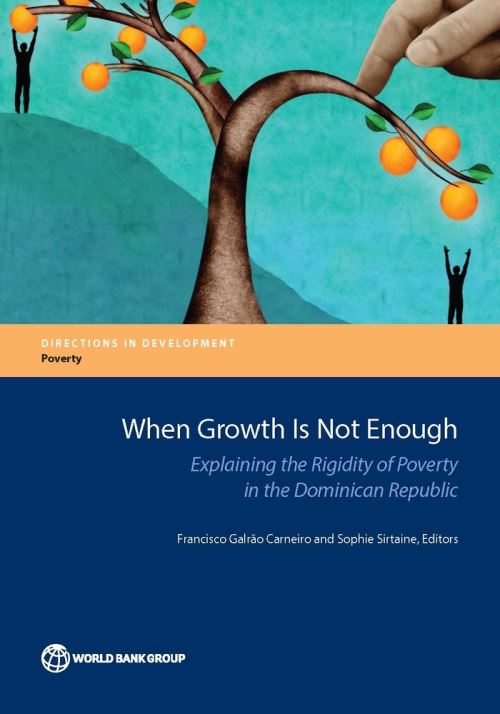
The Dominican Republic stands out as a fast growing economy that has not been able to generate a commensurate reduction in poverty. Three reasons have been raised before to explain this conundrum:
(i) a labor market that does not translate productivity gains into salary increases
(ii) a domestic economy with weak inter-sectoral linkages
(iii) and a public sector that does not spend enough nor particularly well to reduce poverty. In addition, the country remains largely exposed to natural disasters and exogenous shocks that, if not mitigated properly, may affect the sustainability of growth in the medium and longer terms. This book assembles a collection of empirical analyses that explore three complementary hypotheses that could help understand why the Dominican Republic continues, to this date, experiencing high economic growth rates with limited poverty reduction. The first hypothesis is concerned with testing whether the observed pattern of fast economic growth cum persistent poverty in the DR is partly driven by a poverty methodology that does not account for price variation that affects distinctly the consumption patterns of low-income and better-off households. If that hypothesis holds, the DR may face a situation in which household income for households at the bottom of the distribution is underestimated. The second hypothesis tests whether the pattern of specialization in the DR might be such that it does not favor unskilled labor. If that hypothesis holds, then returns to capital are probably much higher than returns to labor which would be an indication that the DR has had a comparative advantage in products that are capital intensive instead of labor-intensive. The third hypothesis investigates whether poverty and wage inequality in the DR are affected not only by immigration but also by emigration. The contribution of the volume, therefore, lies in precisely offering a more careful exploration of specific issues around common explanations for the shortcomings of the DR in reducing poverty on a faster basis
Buy from our bookstore and 25% of the cover price will be given to a school of your choice to buy more books. *15% of eBooks.
Frequently asked questions
The Dominican Republic stands out as a fast growing economy that has not been able to generate a commensurate reduction in poverty. Three reasons have been raised before to explain this conundrum: (i) a labor market that does not translate productivity gains into salary increases; (ii) a domestic economy with weak inter-sectoral linkages; (iii) and a public sector that does not spend enough nor particularly well to reduce poverty.
When Growth Is Not Enough features in the following genres: Poverty and precarity
Paperback. Not Available.
When Growth Is Not Enough was written by World Bank Group and published by World Bank Publications an imprint of The World Bank
Join our community for the latest bookish news, reading recommendations, exclusive opening extracts, author events and competitions. It\'s all free. And enter a monthly draw to win a £50 Gift Card. See past winners here