

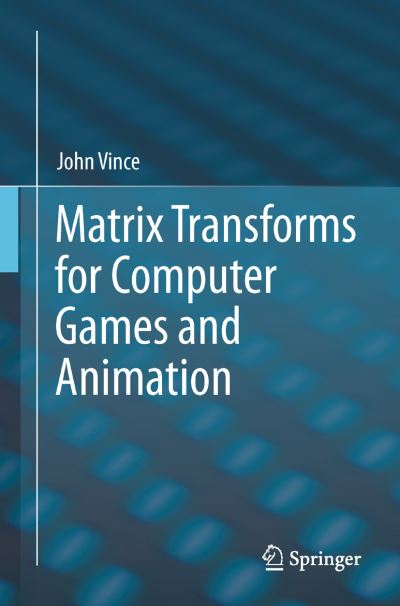
Matrix transforms are ubiquitous within the world of computer graphics, where they have become an invaluable tool in a programmer's toolkit for solving everything from 2D image scaling to 3D rotation about an arbitrary axis. Virtually every software system and hardware graphics processor uses matrices to undertake operations such as scaling, translation, reflection and rotation. Nevertheless, for some newcomers to the world of computer games and animation, matrix notation can appear obscure and challenging.
Matrices and determinants were originally used to solve groups of simultaneous linear equations, and were subsequently embraced by the computer graphics community to describe the geometric operations for manipulating two- and three-dimensional structures. Consequently, to place matrix notation within an historical context, the author provides readers with some useful background to their development, alongside determinants.
Although it is assumed that the reader is familiar with everyday algebra and the solution of simultaneous linear equations, Matrix Transforms for Computer Games and Animation does not expect any prior knowledge of matrix notation. It includes chapters on matrix notation, determinants, matrices, 2D transforms, 3D transforms and quaternions, and includes many worked examples to illustrate their practical use.
| ISBN: | 9781447143208 |
| Publication date: | 28th June 2012 |
| Author: | John Vince |
| Publisher: | Springer an imprint of Springer London |
| Format: | Paperback |
| Pagination: | 166 pages |
| Genres: |
Image processing Computer vision Mathematics |
Matrix transforms are ubiquitous within the world of computer graphics, where they have become an invaluable tool in a programmer's toolkit for solving everything from 2D image scaling to 3D rotation about an arbitrary axis. Virtually every software system and hardware graphics processor uses matrices to undertake operations such as scaling, translation, reflection and rotation.
Matrix Transforms for Computer Games and Animation features in the following genres: Image processing, Computer vision, Mathematics
Paperback, Ebook. Not Available.
Matrix Transforms for Computer Games and Animation was written by John Vince and published by Springer an imprint of Springer London
Matrix Transforms for Computer Games and Animation has 166 pages