

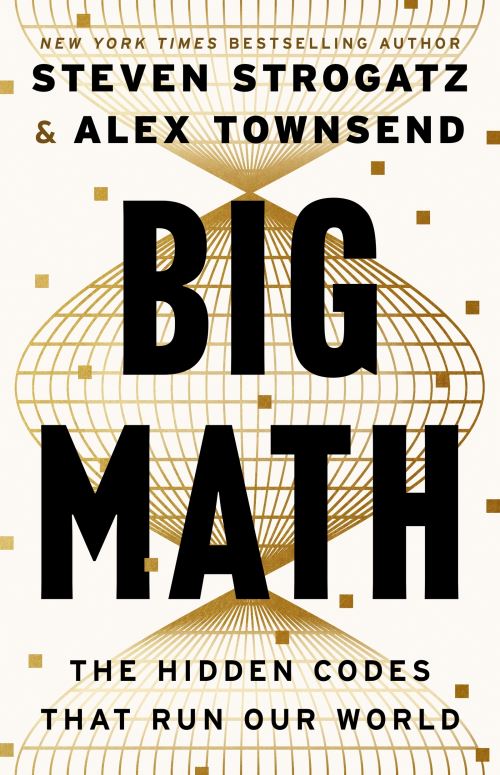
Imagine every photo on your phone, every movie you stream, and every secure credit card transaction you make online. Big Math (i.e., linear algebra) is operating under the hood for each of these everyday miracles. It is:- The mathematical machinery that compresses images so they can be quickly uploaded to Instagram.
- The secret sauce behind Netflix to recommend your next favorite show. - The sentinel that encrypts your data to keep it safe from prying eyes. - The force behind Google's search algorithm allowing you to sift through the vastness of the internet with a few keystrokes.The brainpower enabling the AI revolution, from self-driving cars to large language models like ChatGPT.Big math provides the concepts and algorithms needed in today's digital world.
Yet Big Math isn't limited to practical applications. It promotes a broader, multi-dimensional thinking style critical for solving problems in all walks of life. It teaches us to see and manipulate relationships in a cloud of numbers, understand structures and patterns, and simplify complex problems into manageable pieces.
This skill set is invaluable for scientists, engineers, programmers, entrepreneurs, financial quants, and anyone who deals with the colossal amounts of data that define our information-saturated age.BIG MATH is the first book to introduce linear algebra to a non-technical audience - exploring what it is, who created it, and why it matters.
| ISBN: | 9781399819992 |
| Publication date: | 19th November 2026 |
| Author: | Steven Strogatz, Alex Townsend |
| Publisher: | John Murray an imprint of John Murray Press |
| Format: | Paperback |
| Pagination: | 304 pages |
| Genres: |
Mathematics Popular Science Information technology: general topics Computer science |
Imagine every photo on your phone, every movie you stream, and every secure credit card transaction you make online. Big Math (i.e., linear algebra) is operating under the hood for each of these everyday miracles.
Big Math features in the following genres: Mathematics, Popular Science, Information technology: general topics, Computer science
Paperback, Hardback. Not Available.
Big Math was written by Steven Strogatz, Alex Townsend and published by John Murray an imprint of John Murray Press
Big Math has 304 pages