

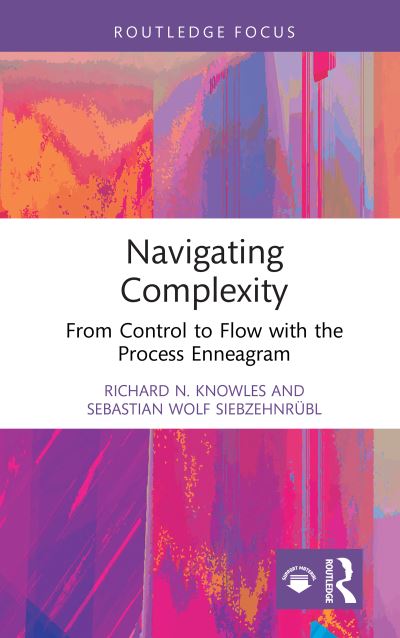
In times of felt polycrisis, when organisations face genuinely complex problems, their instinct is to tighten control. This book shows why that instinct fails and what leaders can do instead, offering a systemic framework for enabling and harnessing collective intelligence.
At its centre is the Process Enneagram, a nine-point participatory instrument tested and refined over decades in chemical plants, sugar mills, and public institutions. The book documents cases where injury rates fell 97% in two years and held for six more, where a production unit was rescued at half the cost and time, and where the conditions that produced those results were built deliberately rather than forced by crisis. It also documents where the approach reached its limits. The argument joins a century-old conversation about non-heroic leadership, beginning with Mary Parker Follett's insistence on power-with rather than power-over. It draws on Donella Meadows on indicators that lead rather than lag, Amy Edmondson on psychological safety as the mechanism behind extraordinary performance, Peggy Holman's pattern of disrupt, differentiate and cohere, Margaret Wheatley's work on self-organisation, Gerald Midgley's systemic intervention, Michael Quinn Patton's developmental evaluation, and Richard Knowles' practice, blending the power of the Process Enneagram with the theories of complexity and complex adaptive systems. The result is a framework that lets a group see its whole system, its parts and their interactions, at once.
The book offers methods for curating diverse perspectives, generating powerful questions, holding tension, and scaling change. It is written for practitioners and facilitators in organisational development, leaders and managers responsible for change, and researchers and graduate students in systems thinking, complexity science and leadership studies, with application across manufacturing, social work, public administration, education, and healthcare. Readers gain a usable instrument, the reasoning that makes it adaptable to their own contexts, and a defensible answer to how self-organisation can be created deliberately.
| ISBN: | 9781041230410 |
| Publication date: | 14th January 2027 |
| Author: | Richard N Knowles, Sebastian Wolf Siebzehnrübl |
| Publisher: | Routledge an imprint of Taylor & Francis |
| Format: | Hardback |
| Pagination: | 152 pages |
| Series: | Systems Thinking |
| Genres: |
Management: leadership and motivation Organizational theory and behaviour Business strategy |
In times of felt polycrisis, when organisations face genuinely complex problems, their instinct is to tighten control. This book shows why that instinct fails and what leaders can do instead, offering a systemic framework for enabling and harnessing collective intelligence.
Navigating Complexity features in the following genres: Management: leadership and motivation, Organizational theory and behaviour, Business strategy
Hardback. £61.19, down from the £67.99 cover price. Not Available.
Navigating Complexity was written by Richard N Knowles, Sebastian Wolf Siebzehnrübl and published by Routledge an imprint of Taylor & Francis
Navigating Complexity has 152 pages
Yes it is part of Systems Thinking series
£61.19, reduced from £67.99. Not Available.