

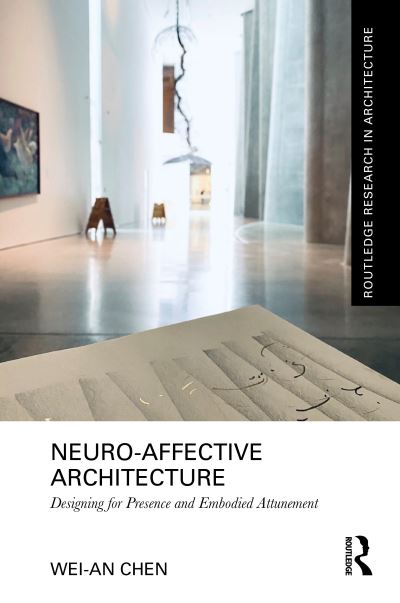
This book is about the inner life of buildings-how architecture lands in the body, moment by moment, as breath, posture, tension, ease, and attention.
It begins with a quiet question: why do so many spaces look extraordinary yet feel lacking from the inside? When image, performance, and optimisation dominate the narrative, the subtler work of space-how it steadies or unsettles the nervous system-often goes unnamed. Moving between neuroscience, phenomenology, movement psychology, and somatic practice, this book names that work as presence and offers a way to design with it.
Presence is treated not as a mood or mystique, but as an embodied attunement: the sensed conversation between environment and organism. Rhythm, light, texture, proportion, threshold, and sequence become cues-inviting calm, alertness, curiosity, or strain. A neuro-affective design framework, informed by Polyvagal Theory and the Kestenberg Movement Profile, is developed through practice-based, autoethnographic enquiry, using the author's own body as an instrument of measurement.
A sensory notation system-inspired by music and dance-maps how atmospheres shift as we move, pause, and turn, and the method is tested through close, embodied readings of architectural works known for their potent atmospheres. The result is a set of concepts, diagrams, and notational tools that help designers articulate what is usually left to intuition: how space touches us and how it might move us better.
Neuro-Affective Architecture will resonate with readers who are curious about presence-what it is, how it arises, and how architecture might serve as a vehicle for cultivating it, while supporting regulation of the nervous system. It is written for architects and spatial designers, educators, and researchers, especially those working at the intersection of atmosphere, embodied experience, and well-being-who want language and methods for designing not only what buildings are, but how they feel to inhabit.
| ISBN: | 9781041099888 |
| Publication date: | 7th August 2026 |
| Author: | WeiAn Chen |
| Publisher: | Routledge an imprint of Taylor & Francis |
| Format: | Hardback |
| Pagination: | 302 pages |
| Series: | Routledge Research in Architecture |
| Genres: |
Theory of architecture Architecture: interior design Physiological and neuro-psychology, biopsychology |
This book is about the inner life of buildings-how architecture lands in the body, moment by moment, as breath, posture, tension, ease, and attention.It begins with a quiet question: why do so many spaces look extraordinary yet feel lacking from the inside? When image, performance, and optimisation dominate the narrative, the subtler work of space-how it steadies or unsettles the nervous system-often goes unnamed.
Neuro-Affective Architecture features in the following genres: Theory of architecture, Architecture: interior design, Physiological and neuro-psychology, biopsychology
Hardback. £154.79, down from the £171.99 cover price. Not Available.
Neuro-Affective Architecture was written by WeiAn Chen and published by Routledge an imprint of Taylor & Francis
Neuro-Affective Architecture has 302 pages
Yes it is part of Routledge Research in Architecture series
£154.79, reduced from £171.99. Not Available.