

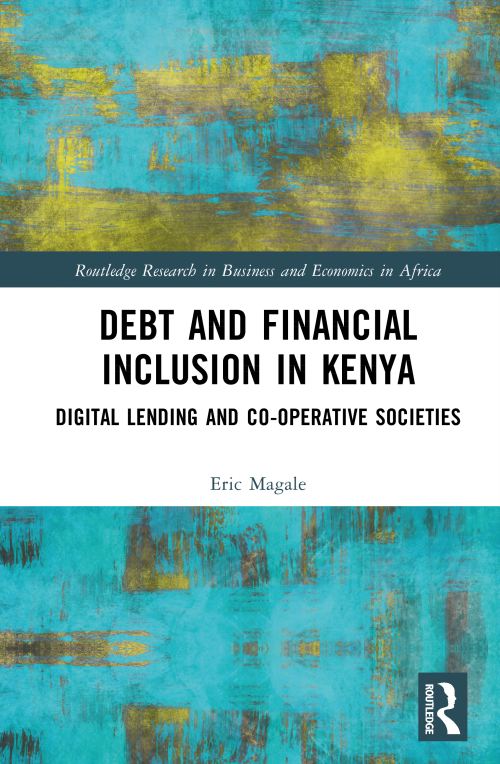
What is the relationship of the people of Kenya to credit and debt? Exploring two increasingly popular financial services providers, digital lenders, and cooperative societies, Debt and Financial Inclusion in Kenya identifies fundamental flaws in financial inclusion strategies deployed in Kenya and their ability to alleviate poverty.
Co-operatives have long been important institutions for low- to middle-income Kenyans, long before the financial inclusion discourse came about. But it was the advent of mobile money in 2008 that transformed Kenya's financial services industry tremendously and saw different fintech innovations built on the M-Pesa platform.
In the last decade or so, there has been a digital credit boom in Kenya with institutions of different kinds, and more recently the government offering microloans to millions of Kenyans, arguing that that credit has the potential to help the poor forge their paths out of poverty. Based on extensive original research, this book examines how digital lenders and Savings and Credit Co-operative Societies (SACCOs) go about extending credit, and how borrowers experience this.
The book shows that digital credit is an important component of a Kenyan's credit mix. However, the use of digital credit varies greatly between people who occupy different income classes. For the poor, who are the targets of financial inclusion, these loans often take the form of 'bad credit' which compromises their financial health, leaving them overindebted.
The book explains the ways in which the current monetary system does not work for the poor, arguing that true financial inclusion can only be achieved via a fundamental rethinking of the money system.
Exposing important problems of speculative profiteering and the financialization of the poor, Debt and Financial Inclusion in Kenya will be an important read for researchers of finance, banking, and development in Africa.
| ISBN: | 9781041093824 |
| Publication date: | 26th March 2026 |
| Author: | Eric Magale |
| Publisher: | Routledge an imprint of Taylor & Francis |
| Format: | Hardback |
| Pagination: | 210 pages |
| Series: | Routledge Research on African Economics |
| Genres: |
Development economics and emerging economies Credit and credit institutions Small businesses and self-employment Social discrimination and social justice Poverty and precarity Sociology: work and labour Public administration International economics Regional / International studies Development studies |
What is the relationship of the people of Kenya to credit and debt? Exploring two increasingly popular financial services providers, digital lenders, and cooperative societies, Debt and Financial Inclusion in Kenya identifies fundamental flaws in financial inclusion strategies deployed in Kenya and their ability to alleviate poverty.Co-operatives have long been important institutions for low- to middle-income Kenyans, long before the financial inclusion discourse came about.
Debt and Financial Inclusion in Kenya features in the following genres: Development economics and emerging economies, Credit and credit institutions, Small businesses and self-employment, Social discrimination and social justice, Poverty and precarity, Sociology: work and labour, Public administration, International economics, Regional / International studies, Development studies
Hardback. £154.79, down from the £171.99 cover price. Not Available.
Debt and Financial Inclusion in Kenya was written by Eric Magale and published by Routledge an imprint of Taylor & Francis
Debt and Financial Inclusion in Kenya has 210 pages
Yes it is part of Routledge Research on African Economics series
£154.79, reduced from £171.99. Not Available.