

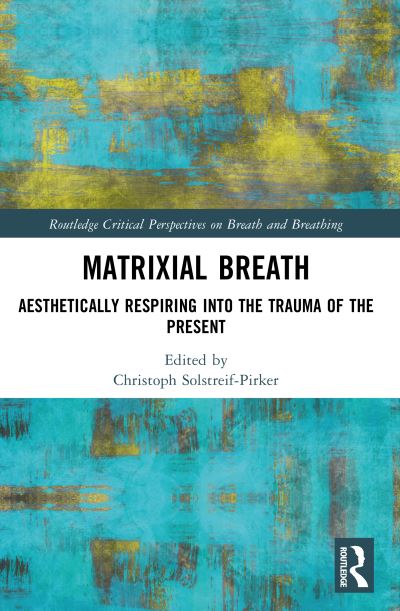
Day by day, the global climate crisis intensifies, yet there are little changes in the behavior of privileged societies. This book reveals that such paradoxical behavior is due to the prevalence of a narrative that considers planet Earth as a self-sustaining system, driven by a circular respiration pattern from one actor to the next. It argues that transforming this prevailing planetary breathing pattern is necessary to change humans' destructive behavior towards the morethan- human environment. The volume, in particular, references the feminine Matrixial Theory of psychoanalyst and philosopher Bracha L. Ettinger. In linking the Matrixial Theory to environmental issues for the first time, it explores the rhythms and scopes of a Matrixial breath and what alternative forms of relationship between humans and nature might emerge from it. It lays the foundation for an urgently needed subversion of thought and action toward novel ethics of breathing-with beyond homeostatic reductionism.
The first of its kind, this volume will be indispensable for students and researchers of environmental ethics, feminist thought, climate studies, social change, or critical theory. It will also be useful to cultural scientists, artists, philosophers, ecologists, theologians, architects, therapists, social workers, educators, and politicians.
| ISBN: | 9781032993515 |
| Publication date: | 28th December 2026 |
| Author: | |
| Publisher: | Routledge India an imprint of Taylor & Francis |
| Format: | Paperback |
| Pagination: | 136 pages |
| Series: | Routledge Critical Perspectives on Breath and Breathing |
| Genres: |
Environmentalist thought and ideology Feminism and feminist theory Ethics and moral philosophy |
Day by day, the global climate crisis intensifies, yet there are little changes in the behavior of privileged societies. This book reveals that such paradoxical behavior is due to the prevalence of a narrative that considers planet Earth as a self-sustaining system, driven by a circular respiration pattern from one actor to the next.
features in the following genres: Environmentalist thought and ideology, Feminism and feminist theory, Ethics and moral philosophy
Paperback, Book, Hardback, Board book, Ebook, . £43.19, down from the £47.99 cover price. Not Available.
was written by and published by Routledge India an imprint of Taylor & Francis
has 136 pages
Yes it is part of Routledge Critical Perspectives on Breath and Breathing series
£43.19, reduced from £47.99. Not Available.