

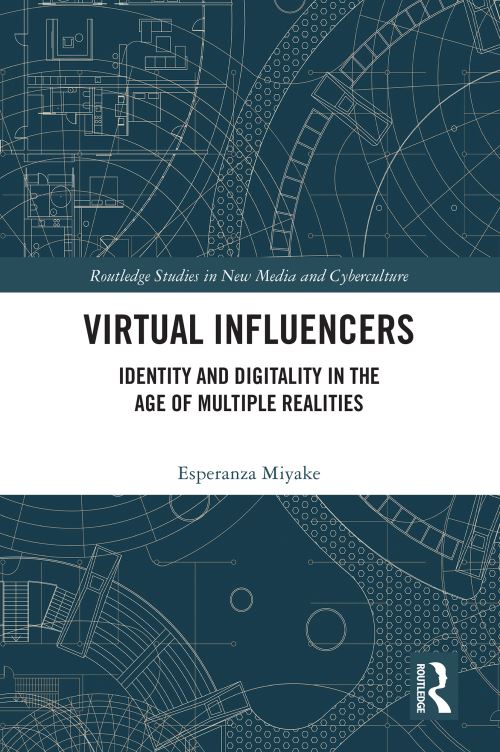
This book identifies the converging socio- cultural, economic, and technological conditions that have shaped, informed, and realised the identity of the contemporary virtual influencer, situating them at the intersection of social media, consumer culture, Artificial Intelligence (AI), and digital technologies.Through a critical analysis of virtual influencers and related media practices and discourses in an international context, each chapter investigates different themes relating to digitality and identity: virtual place and nationhood; virtual emotions and intimacy; im/ materialities of virtual everyday life; the biopolitics of virtual human-production; the necropolitics of pandemic virtuality; transmedial and mimetic virtualities; and the political economy of virtual influencers.
The book argues that the virtual influencer represents the various ways in which contemporary identities have increasingly become naturalised with questions of virtuality, mediated by digital technologies across multiple realities.From practices relating to AI- driven, invasive data profiling needed for virtual influencer production to problematic online practices such as buying digital skin colour, the author examines how the virtual influencer's aesthetic, social, and economic value obfuscates some of the darker aspects of their role as an extractivist technology of virtuality: one which regulates, oppresses, and/ or classifies bodies and datafied bodies that serve the visual, (bio)political, and digital economies of virtual capitalism.
In the process, the book simultaneously offers a critique of the virtual influencer as a representational figure existing across multiple digital platforms, spaces, and times, and of how they may challenge, complicate, and reinforce normative ideologies surrounding gender, race, class, sexuality, age, and ableism. As such, the book sheds light on some of the more troubling realities of the virtual influencer's existence, inasmuch as it celebrates their transformational potential, exploring the implications of both within an increasingly AI- driven, digital culture, society, and economy.Drawing from a wide range of disciplines, this book will appeal to scholars, researchers, and students working in the area(s) of:
| ISBN: | 9781032559735 |
| Publication date: | 26th December 2025 |
| Author: | Esperanza Miyake |
| Publisher: | Routledge an imprint of Taylor & Francis |
| Format: | Paperback |
| Pagination: | 216 pages |
| Series: | Routledge Studies in New Media and Cyberculture |
| Genres: |
Media studies Popular culture Disability: social aspects Gender studies, gender groups Ethnic studies Information technology industries Communication studies Sociology Sales and marketing History The Arts |
This book identifies the converging socio- cultural, economic, and technological conditions that have shaped, informed, and realised the identity of the contemporary virtual influencer, situating them at the intersection of social media, consumer culture, Artificial Intelligence (AI), and digital technologies.Through a critical analysis of virtual influencers and related media practices and discourses in an international context, each chapter investigates different themes relating to digitality and identity: virtual place and nationhood; virtual emotions and intimacy; im/ materialities of virtual everyday life; the biopolitics of virtual human-production; the necropolitics of pandemic virtuality; transmedial and mimetic virtualities; and the political economy of virtual influencers. The book argues that the virtual influencer represents the various ways in which contemporary identities have increasingly become naturalised with questions of virtuality, mediated by digital technologies across multiple realities.From practices relating to AI- driven, invasive data profiling needed for virtual influencer production to problematic online practices such as buying digital skin colour, the author examines how the virtual influencer's aesthetic, social, and economic value obfuscates some of the darker aspects of their role as an extractivist technology of virtuality: one which regulates, oppresses, and/ or classifies bodies and datafied bodies that serve the visual, (bio)political, and digital economies of virtual capitalism.
Virtual Influencers features in the following genres: Media studies, Popular culture, Disability: social aspects, Gender studies, gender groups, Ethnic studies, Information technology industries, Communication studies, Sociology, Sales and marketing, History, The Arts
Paperback, Hardback. £43.19, down from the £47.99 cover price. Not Available.
Virtual Influencers was written by Esperanza Miyake and published by Routledge an imprint of Taylor & Francis
Virtual Influencers has 216 pages
Yes it is part of Routledge Studies in New Media and Cyberculture series
£43.19, reduced from £47.99. Not Available.