

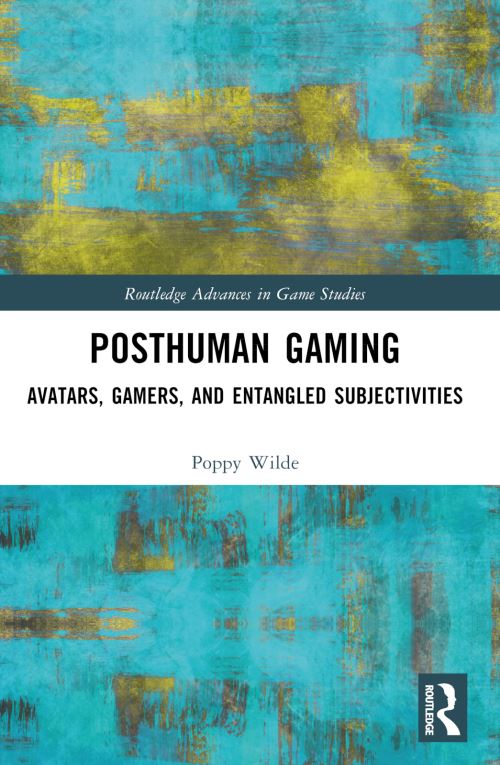
Posthuman Gaming: Avatars, Gamers, and Entangled Subjectivities explores the relationship between avatar and gamer in the massively multiplayer online roleplaying game World of Warcraft, to examine notions of entangled subjectivity, affects, and embodiments - what it means and how it feels to be posthuman.
With a focus on posthuman subjectivity, Wilde considers how we can begin to articulate ourselves when the boundary between self and other is unclear. Drawing on fieldnotes of her own gameplay experiences, the author analyses how subjectivity is formed in ways that defy a single individual notion of "self", and explores how different practices, feelings, and societal understandings can disrupt strict binaries and emphasise our posthumanism.
She interrogates if one can speak of an "I" in the face of posthuman multiplicity, before exploring different analytical themes, beginning with how acting theories might be posthumanised and articulate the relationship between avatar and gamer. She then defines posthuman empathy and explains how this is experienced in gaming, before addressing the need to account for boredom, the complexity of nostalgia, and ways death and loss are experienced through gaming.
This volume will appeal to a broad audience and is particularly relevant to scholars and students of cultural studies, media studies, humanities, and game studies.
| ISBN: | 9781032074962 |
| Publication date: | 18th December 2024 |
| Author: | Poppy Wilde |
| Publisher: | Routledge an imprint of Taylor & Francis |
| Format: | Paperback |
| Pagination: | 222 pages |
| Series: | Routledge Advances in Game Studies |
| Genres: |
Media studies Popular culture Digital and information technologies: social and ethical aspects Digital and information technologies: Legal aspects Digital animation Games development and programming Human–computer interaction Philosophy The Arts |
Posthuman Gaming: Avatars, Gamers, and Entangled Subjectivities explores the relationship between avatar and gamer in the massively multiplayer online roleplaying game World of Warcraft, to examine notions of entangled subjectivity, affects, and embodiments - what it means and how it feels to be posthuman.With a focus on posthuman subjectivity, Wilde considers how we can begin to articulate ourselves when the boundary between self and other is unclear. Drawing on fieldnotes of her own gameplay experiences, the author analyses how subjectivity is formed in ways that defy a single individual notion of "self", and explores how different practices, feelings, and societal understandings can disrupt strict binaries and emphasise our posthumanism.
Posthuman Gaming features in the following genres: Media studies, Popular culture, Digital and information technologies: social and ethical aspects, Digital and information technologies: Legal aspects, Digital animation, Games development and programming, Human–computer interaction, Philosophy, The Arts
Paperback, Hardback. £39.59, down from the £43.99 cover price. Not Available.
Posthuman Gaming was written by Poppy Wilde and published by Routledge an imprint of Taylor & Francis
Posthuman Gaming has 222 pages
Yes it is part of Routledge Advances in Game Studies series
£39.59, reduced from £43.99. Not Available.