

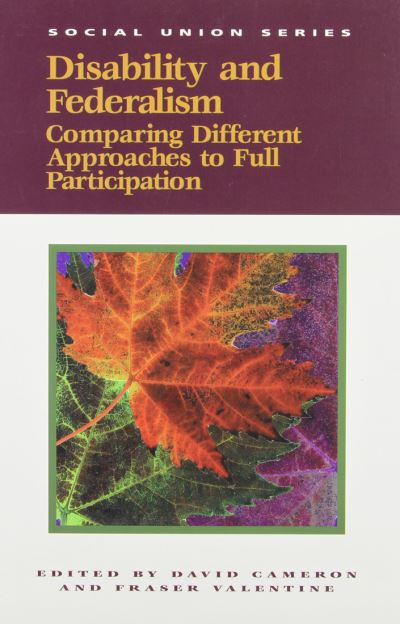
All modern democratic states have fashioned policies and programs in response to the needs of persons with disabilities. These vary from nation to nation and in Disability and Federalism the authors examine the impact of the federal regimes of Australia, Belgium, Canada, Germany, and the United States on disability policy and programs and evaluate whether disablement - including its international, organizational, political, and attitudinal dimensions - has affected the operation of federalism in the five countries studied.
The conclusion that emerges is that neither federalism nor the specific type of federal regime makes much difference to the philosophy of government, the values that underlie policy-making, or the general policy orientation to disabled people at any given historical moment. Individual federal realities, however, are at the heart of the formation of disability policy and the striking variations in program design and delivery that occur between states.
Contributors include David Cameron, Linda Hancock (Deakin University, Australia), Ursula Muench (Universität der Bunderswehr Muenchen), Stephen L.Percy (University of Wisconsin-Milwaukee), Johanne Poirier (Université Libre de Bruxelles and University of Cambridge), Sherri Torjman (Caledon Institute of Social Policy, Ottawa), and Fraser Valentine.
| ISBN: | 9780889118676 |
| Publication date: | 31st March 2002 |
| Author: | David Cameron |
| Publisher: | Institute of Intergovernmental Relations an imprint of McGill-Queen's University Press |
| Format: | Hardback |
| Pagination: | 288 pages |
| Series: | Queen's Policy Studies Series |
| Genres: |
Social work Political structure and processes |
All modern democratic states have fashioned policies and programs in response to the needs of persons with disabilities. These vary from nation to nation and in Disability and Federalism the authors examine the impact of the federal regimes of Australia, Belgium, Canada, Germany, and the United States on disability policy and programs and evaluate whether disablement - including its international, organizational, political, and attitudinal dimensions - has affected the operation of federalism in the five countries studied.
Disability and Federalism features in the following genres: Social work, Political structure and processes
Hardback, Paperback. Not Available.
Disability and Federalism was written by David Cameron and published by Institute of Intergovernmental Relations an imprint of McGill-Queen's University Press
Disability and Federalism has 288 pages
Yes it is part of Queen's Policy Studies Series series