

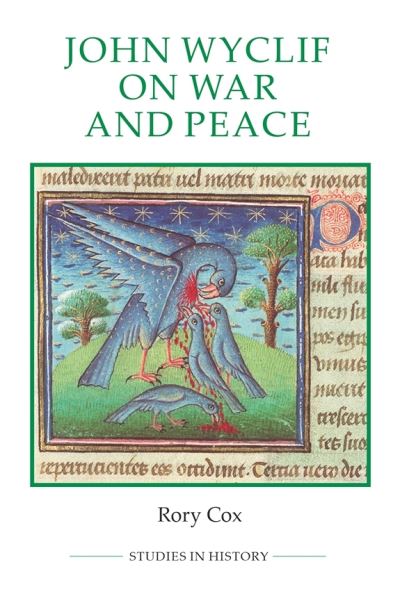
New investigation of John Wyclif's writings on the theory of the "just war" shows him to be the first genuine pacifist of medieval Europe. John Wyclif (c. 1330-84) was the foremost English intellectual of the late fourteenth century and is remembered as both an ecclesiastical reformer and a heresiarch. But, against the backdrop of the Hundred Years War, Wyclif also tackled the numerous ethical, legal and practical problems arising from war and violence. Since the fifth-century works of St Augustine of Hippo, Christian justifications of war had revolved around three key criteria: just cause, proper authority and correct intention. Utilising Wyclif's extensive Latin corpus, the author traces how and why Wyclif dismantled these three pillars of medieval just war doctrine, exploring his critique within the context oflate medieval political thought and theology. Wyclif is revealed to be a thinker deeply concerned with the Christian virtues of sacrifice, suffering and charity, which ultimately led him to repudiate the concept of justified warfare in both theory and practice. The author thus changes the way we understand Wyclif, demonstrating that he created a coherent doctine of pacifism and non-resistance which was at that time unparallelled. Dr Rory Cox isa Lecturer in Late Mediaeval History at the University of St Andrews.
| ISBN: | 9780861933259 |
| Publication date: | 16th October 2014 |
| Author: | Rory Cox |
| Publisher: | Royal Historical Society an imprint of Boydell & Brewer Ltd |
| Format: | Hardback |
| Pagination: | 214 pages |
| Series: | Royal Historical Society Studies in History. New Series |
| Genres: |
European history: medieval period, middle ages History of religion Christianity |
New investigation of John Wyclif's writings on the theory of the "just war" shows him to be the first genuine pacifist of medieval Europe. John Wyclif (c. 1330-84) was the foremost English intellectual of the late fourteenth century and is remembered as both an ecclesiastical reformer and a heresiarch. But, against the backdrop of the Hundred Years War, Wyclif also tackled the numerous ethical, legal and practical problems arising from war and violence. Since the fifth-century works of St Augustine of Hippo, Christian justifications of war had revolved around three key criteria: just cause, proper authority and correct intention. Utilising Wyclif's extensive Latin corpus, the author traces how and why Wyclif dismantled these three pillars of medieval just war doctrine, exploring his critique within the context oflate medieval political thought and theology. Wyclif is revealed to be a thinker deeply concerned with the Christian virtues of sacrifice, suffering and charity, which ultimately led him to repudiate the concept of justified warfare in both theory and practice. The author thus changes the way we understand Wyclif, demonstrating that he created a coherent doctine of pacifism and non-resistance which was at that time unparallelled. Dr Rory Cox isa Lecturer in Late Mediaeval History at the University of St Andrews.
John Wyclif on War and Peace features in the following genres: European history: medieval period, middle ages, History of religion, Christianity
John Wyclif on War and Peace is available in Hardback, Ebook
John Wyclif on War and Peace was written by Rory Cox and published by Royal Historical Society an imprint of Boydell & Brewer Ltd
John Wyclif on War and Peace has 214 pages
Yes it is part of Royal Historical Society Studies in History. New Series series