

Duffy plunges full-throttle into speed's “adrenaline aesthetics,” offering deft readings of works ranging from F. Scott Fitzgerald's The Great Gatsby, through J. G. Ballard's Crash, to the cautionary consumerism of Ralph Nader. He describes how speed changed understandings of space, distance, chance, and violence; how the experience of speed was commodified in the dawning era of mass consumption; and how society was incited to abhor slowness and desire speed.
He examines how people were trained by new media such as the cinema to see, hear, and sense speed, and how speed, demanded of the efficient assembly-line worker, was given back to that worker as the chief thrill of leisure. Assessing speed's political implications, Duffy considers how speed pleasure was offered to citizens based on criteria including their ability to pay and their gender, and how speed quickly became something to be patrolled by governments.
Drawing on novels, news reports, photography, advertising, and much more, Duffy provides a breakneck tour through the cultural dynamics of speed.
| ISBN: | 9780822344308 |
| Publication date: | 20th July 2009 |
| Author: | Enda Duffy |
| Publisher: | Duke University Press |
| Format: | Hardback |
| Pagination: | 306 pages |
| Series: | Post-Contemporary Interventions |
| Genres: |
Literary theory |
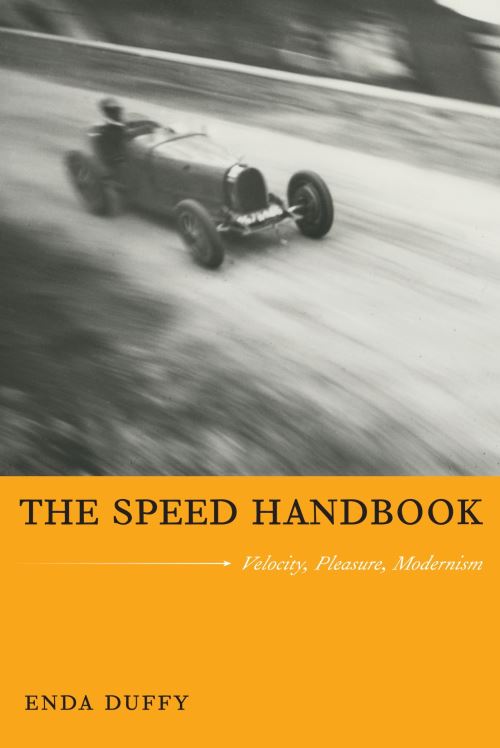
Speed, the sensation one gets when driving fast, was described by Aldous Huxley as the single new pleasure invented by modernity. The Speed Handbook is a virtuoso exploration of Huxley's claim.
The Speed Handbook features in the following genres: Literary theory
Paperback, Hardback. Not Available.
The Speed Handbook was written by Enda Duffy and published by Duke University Press
The Speed Handbook has 306 pages
Yes it is part of Post-Contemporary Interventions series