

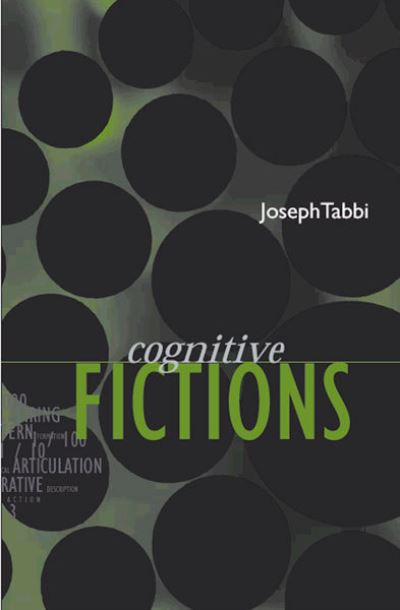
The first comprehensive look at the effect of new technologies on contemporary American fiction
Bringing together cognitive science and literary analysis to map a new "media ecology," Cognitive Fictions limns an evolutionary process in which literature must find its place in an artificial environment partly produced and thoroughly mediated by technological means. Joseph Tabbi provides a penetrating account of a developing consciousness emerging from the struggle between print and electronic systems of communication.
Central to Tabbi's work is the relation between the arrangement of communicating "modules" that cognitive science uses to describe the human mind and the arrangement of visual, verbal, and aural media in our technological culture. He looks at particular literary works by Thomas Pynchon, Richard Powers, David Markson, Lynne Tillman, Paul Auster, and others as both inscriptions of thought consistent with distributed cognitive models, and as self-creations out of the media environment. The first close reading of contemporary American writing in the light of systems theory and cognitive science, Cognitive Fictions makes needed sense of how the moment-by-moment operations of human thought find narrative form in a world increasingly defined by competing and often incompatible representations.| ISBN: | 9780816635573 |
| Publication date: | 27th June 2002 |
| Author: | Joseph Tabbi |
| Publisher: | Univ Of Minnesota Press an imprint of University of Minnesota Press |
| Format: | Paperback |
| Pagination: | 166 pages |
| Series: | Electronic Mediations |
| Genres: |
Literature: history and criticism |
The first comprehensive look at the effect of new technologies on contemporary American fictionBringing together cognitive science and literary analysis to map a new "media ecology," Cognitive Fictions limns an evolutionary process in which literature must find its place in an artificial environment partly produced and thoroughly mediated by technological means. Joseph Tabbi provides a penetrating account of a developing consciousness emerging from the struggle between print and electronic systems of communication.Central to Tabbi's work is the relation between the arrangement of communicating "modules" that cognitive science uses to describe the human mind and the arrangement of visual, verbal, and aural media in our technological culture.
Cognitive Fictions features in the following genres: Literature: history and criticism
Hardback, Paperback. Not Available.
Cognitive Fictions was written by Joseph Tabbi and published by Univ Of Minnesota Press an imprint of University of Minnesota Press
Cognitive Fictions has 166 pages
Yes it is part of Electronic Mediations series