

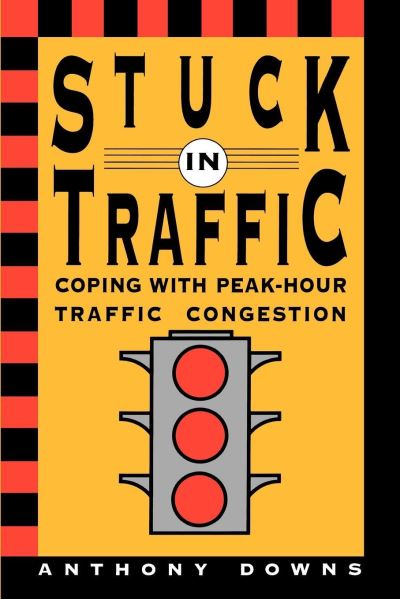
Peak-hour traffic congestion has become a major problem in most U.S. cities. In fact, a majority of residents in metropolitan and suburban areas consider congestion their most serious local problem. As citizens have become increasingly frustrated by repeated traffic delays that cost them money and waste time, congestion has become an important factor affecting local government policies in many parts of the nation. In this new book, Anthony Downs looks at the causes of worsening traffic congestion, especially in suburban areas, and considers the possible remedies. He analyzes the specific advantages and disadvantages of every major strategy that has been proposed to reduce congestion. In nontechnical language, he focuses on two central issues: the relationships between land-use and traffic flow in rapidly growing areas, and whether local policies can effectively reduce congestion or if more regional approaches are necessary. In rapidly growing parts of the country, congestion is worse than it was five or ten years ago. But Downs notes that the problem has apparently not yet become bad enough to stimulate effective responses. Neither government officials nor citizens seem willing to consider changing the behavior and public policies that cause congestion. To alleviate the problem, both groups must be prepared to make these fundamental changes. Selected by Choice as an Outstanding Book of 1992 Co-published with the Lincoln Institute of Land Policy.
| ISBN: | 9780815719236 |
| Publication date: | 1st June 1992 |
| Author: | Anthony Downs |
| Publisher: | Brookings Institution Press an imprint of Brookings Institution Press and the Lincoln Institute of Land Policy |
| Format: | Paperback |
| Pagination: | 224 pages |
| Genres: |
Transport industries Urban and municipal planning and policy Motoring |
Peak-hour traffic congestion has become a major problem in most U.S. cities. In fact, a majority of residents in metropolitan and suburban areas consider congestion their most serious local problem. As citizens have become increasingly frustrated by repeated traffic delays that cost them money and waste time, congestion has become an important factor affecting local government policies in many parts of the nation. In this new book, Anthony Downs looks at the causes of worsening traffic congestion, especially in suburban areas, and considers the possible remedies. He analyzes the specific advantages and disadvantages of every major strategy that has been proposed to reduce congestion. In nontechnical language, he focuses on two central issues: the relationships between land-use and traffic flow in rapidly growing areas, and whether local policies can effectively reduce congestion or if more regional approaches are necessary. In rapidly growing parts of the country, congestion is worse than it was five or ten years ago. But Downs notes that the problem has apparently not yet become bad enough to stimulate effective responses. Neither government officials nor citizens seem willing to consider changing the behavior and public policies that cause congestion. To alleviate the problem, both groups must be prepared to make these fundamental changes. Selected by Choice as an Outstanding Book of 1992 Co-published with the Lincoln Institute of Land Policy.
Stuck in Traffic features in the following genres: Transport industries, Urban and municipal planning and policy, Motoring
Stuck in Traffic is available in Paperback
Stuck in Traffic was written by Anthony Downs and published by Brookings Institution Press an imprint of Brookings Institution Press and the Lincoln Institute of Land Policy
Stuck in Traffic has 224 pages
£19.79