

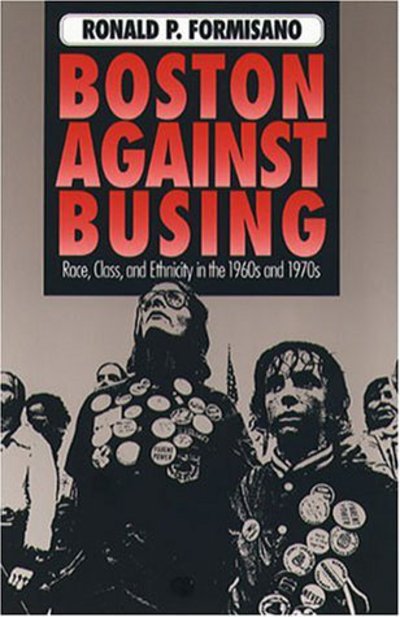
In the 1970s the flashpoint of race relations for many white Americans was court-ordered busing to achieve school desegregation. Busing sparked protests in almost every city in which it was implemented, but perhaps the most volatile reaction occured in Boston, a city known for its high culture, superior education, and liberal populace. In no other city, north or south, did school desegregation prompt such intense and protracted protest.
In Boston Against Busing Ronald Formisano explores the sources of white opposition to school desegregation. He sees white resistance as an example of reactionary populism, a social movement mixing both populist and conservative elements. Racism was a key facor, Formisano argues, but racial prejudice alone cannot explain the movement.
Vigilantism and terrorism were directed as much against moderate whites as against blacks, and class resentment, ethnic rivalries, and the defense of neighborhood turf played powerful roles in the protest.
Whereas previous accounts of Boston's opposition to busing have focused on the working-class neighborhoods of South Boston and Charlestown, Formisano examines a broader spectrum of resistance, especially in middle-class West Roxbury. Different neighborhoods had differing responses to the crisis, he says.
He draws on letters from a cross section of Boston's citizens to the federal judge who presided over the case, W. Arthur Garrity, Jr., letters that detail the gamut of opinion among the opponents of court-ordered busing.
Formisano also points out the connections between the student and black activists of the 1960s and the Boston antibusers fo the 1970s. The Boston protesters, although hostile to the civil rights and student movements, often borrowed their tactics and even their slogans, singing "We Shall Overcome" and chanting "Hell, no, we won't go" as they marched, demonstrated, and often clashed with police.
Since the 1970s Boston schools have become even more segregated by race and class. In evaluating the ultimate failure of desegregation in Boston, Formisano explicitly identifies where public policy went wrong and why. In doing so, he provides an insightful account of one of the most significant grass-roots movements of the 1970s and offers a valuable contribution to understanding the ongoing social problem that school desegregation tried to address.
| ISBN: | 9780807819296 |
| Publication date: | 26th March 1991 |
| Author: | Ronald P Formisano |
| Publisher: | The University of North Carolina Press |
| Format: | Hardback |
| Pagination: | 323 pages |
| Genres: |
History of education Ethnic studies History of the Americas |
In the 1970s the flashpoint of race relations for many white Americans was court-ordered busing to achieve school desegregation. Busing sparked protests in almost every city in which it was implemented, but perhaps the most volatile reaction occured in Boston, a city known for its high culture, superior education, and liberal populace.
Boston Against Busing features in the following genres: History of education, Ethnic studies, History of the Americas
Ebook, Paperback, Hardback. Not Available.
Boston Against Busing was written by Ronald P Formisano and published by The University of North Carolina Press
Boston Against Busing has 323 pages