

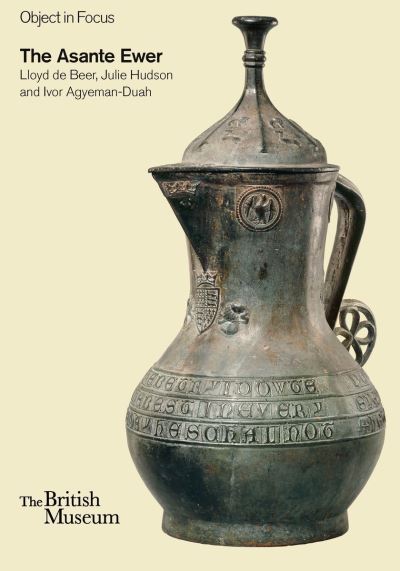
A new title in the British Museum's Object in Focus series that unpacks the history of a fascinating vessel and its journey from medieval England to West Africa and back.
The fourteenth-century metal jug today popularly known as the Asante Ewer has a remarkable story. It was made in medieval England but transported to West Africa, possibly at some point between the fifteenth and seventeenth centuries. By the nineteenth century it was located in a courtyard associated with the royal palace of the Asantehene, the king of the Asante people in Kumasi, present-day Ghana. During widespread looting by British forces in the aftermath of the so-called Fourth Anglo-Asante War of 1896, the ewer was removed from the royal building and subsequently purchased by the British Museum.
This book includes a detailed close reading of the object itself, which is one of the finest examples of late medieval English bronze casting. It also explores the significance of the vessel in both European and African contexts - from the intricate medieval symbolism, linked to English royalty, that forms its decoration, to its potential connections with the trade in ivory and gold across the Sahara and the West African coast. Finally, this publication addresses collecting practices of the nineteenth century and their inextricable links with colonialism, as well as discussing how the ewer has historically been presented in a European context and is now being re-evaluated to include its African history.
| ISBN: | 9780714138015 |
| Publication date: | 3rd November 2025 |
| Author: | Lloyd De Beer, Julie Hudson, Ivor AgyemanDuah |
| Publisher: | The British Museum Press an imprint of British Museum Press |
| Format: | Paperback |
| Pagination: | 64 pages |
| Series: | Objects in Focus |
| Genres: |
Archaeology by period / region |
A new title in the British Museum's Object in Focus series that unpacks the history of a fascinating vessel and its journey from medieval England to West Africa and back.
The fourteenth-century metal jug today popularly known as the Asante Ewer has a remarkable story. It was made in medieval England but transported to West Africa, possibly at some point between the fifteenth and seventeenth centuries. By the nineteenth century it was located in a courtyard associated with the royal palace of the Asantehene, the king of the Asante people in Kumasi, present-day Ghana. During widespread looting by British forces in the aftermath of the so-called Fourth Anglo-Asante War of 1896, the ewer was removed from the royal building and subsequently purchased by the British Museum.
This book includes a detailed close reading of the object itself, which is one of the finest examples of late medieval English bronze casting. It also explores the significance of the vessel in both European and African contexts - from the intricate medieval symbolism, linked to English royalty, that forms its decoration, to its potential connections with the trade in ivory and gold across the Sahara and the West African coast. Finally, this publication addresses collecting practices of the nineteenth century and their inextricable links with colonialism, as well as discussing how the ewer has historically been presented in a European context and is now being re-evaluated to include its African history.
The Asante Ewer features in the following genres: Archaeology by period / region
The Asante Ewer is available in Paperback
The Asante Ewer was written by Lloyd De Beer, Julie Hudson, Ivor AgyemanDuah and published by The British Museum Press an imprint of British Museum Press
The Asante Ewer has 64 pages
Yes it is part of Objects in Focus series
£5.40