

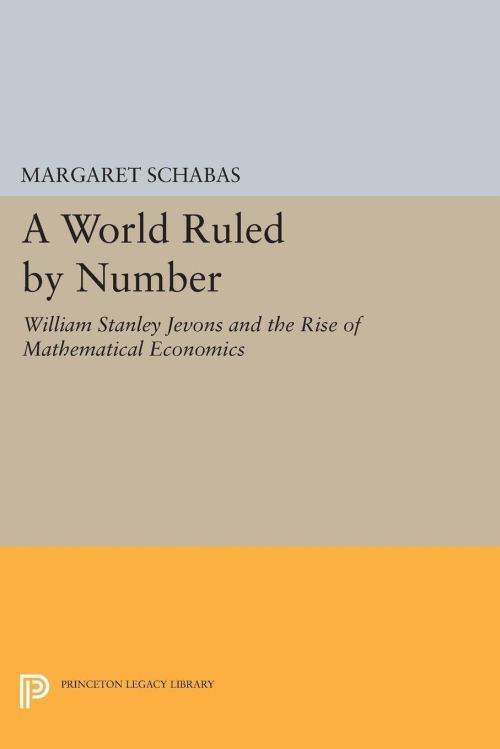
If any single characteristic differentiates current, neoclassical economics from the classical economics of Adam Smith and David Ricardo, it is the use of mathematics. Pointing to the critical role of William Stanley Jevons (1835-1882), Margaret Schabas demonstrates that the advent of mathematical economics in late Victorian England resulted more from new currents in logic and the philosophy of science than from problems specific to the classical theory of value and distribution.
Jevons's Principles of Science (1874) was the first book to take issue with John Stuart Mill's faith in inductive reasoning, to assimilate George Boole's mathematical logic, and to discern many of the limitations that beset scientific inquiry. Together with a renewed appreciation for Bentham's utility calculus, these philosophical insights served to convince Jevons and his followers that the economic world is fundamentally quantitative and thus amenable to mathematical analysis.
Originally published in 1990.
The Princeton Legacy Library uses the latest print-on-demand technology to again make available previously out-of-print books from the distinguished backlist of Princeton University Press. These editions preserve the original texts of these important books while presenting them in durable paperback and hardcover editions. The goal of the Princeton Legacy Library is to vastly increase access to the rich scholarly heritage found in the thousands of books published by Princeton University Press since its founding in 1905.
| ISBN: | 9780691605944 |
| Publication date: | 1st July 2014 |
| Author: | Margaret Schabas |
| Publisher: | Princeton University Press |
| Format: | Paperback |
| Pagination: | 206 pages |
| Series: | Princeton Legacy Library |
| Genres: |
Economic history Economic theory and philosophy |
If any single characteristic differentiates current, neoclassical economics from the classical economics of Adam Smith and David Ricardo, it is the use of mathematics. Pointing to the critical role of William Stanley Jevons (1835-1882), Margaret Schabas demonstrates that the advent of mathematical economics in late Victorian England resulted more from new currents in logic and the philosophy of science than from problems specific to the classical theory of value and distribution.Jevons's Principles of Science (1874) was the first book to take issue with John Stuart Mill's faith in inductive reasoning, to assimilate George Boole's mathematical logic, and to discern many of the limitations that beset scientific inquiry.
A World Ruled by Number features in the following genres: Economic history, Economic theory and philosophy
Paperback. Not Available.
A World Ruled by Number was written by Margaret Schabas and published by Princeton University Press
A World Ruled by Number has 206 pages
Yes it is part of Princeton Legacy Library series