

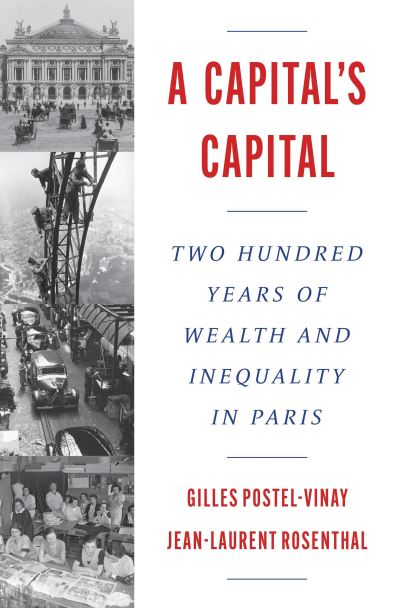
A study of the changes in wealth and its distribution in nineteenth- and twentieth-century Paris that maps the interplay among wealth, inequality, and welfare
Successful economies sustain capital accumulation across generations, and capital accumulation leads to large increases in private wealth. In this book, Gilles Postel-Vinay and Jean-Laurent Rosenthal map the fluctuations in wealth and its distribution in Paris between 1807 and 1977. Drawing on a unique dataset of the bequests of almost 800,000 Parisians, they show that real wealth per decedent varied immensely during this period while inequality began high and declined only slowly. Parisians' portfolios document startling changes in the geography and types of wealth over time.
Postel-Vinay and Rosenthal's account reveals the impact of economic factors (large shocks, technological changes, differential returns to wealth), political factors (changes in taxation), and demographic and social factors (age and gender) on wealth and inequality. Before World War I, private wealth was highly predictive of other indicators of welfare, including different forms of human capital, age at death, and access to local public goods. After World War I, public intervention reduced-but did not eliminate-the strong connection between wealth inequality and other forms of inequality. Over the two centuries covered, Paris and its wealth were on the vanguard of economic and social change that affected the rest of the country a generation later.
| ISBN: | 9780691276113 |
| Publication date: | 31st March 2026 |
| Author: | Gilles PostelVinay, JeanLaurent Rosenthal |
| Publisher: | Princeton University Press |
| Format: | Hardback |
| Pagination: | 464 pages |
| Series: | The Princeton Economic History of the Western World |
| Genres: |
Economic history Capitalism European history |
A study of the changes in wealth and its distribution in nineteenth- and twentieth-century Paris that maps the interplay among wealth, inequality, and welfare
Successful economies sustain capital accumulation across generations, and capital accumulation leads to large increases in private wealth. In this book, Gilles Postel-Vinay and Jean-Laurent Rosenthal map the fluctuations in wealth and its distribution in Paris between 1807 and 1977. Drawing on a unique dataset of the bequests of almost 800,000 Parisians, they show that real wealth per decedent varied immensely during this period while inequality began high and declined only slowly. Parisians' portfolios document startling changes in the geography and types of wealth over time.
Postel-Vinay and Rosenthal's account reveals the impact of economic factors (large shocks, technological changes, differential returns to wealth), political factors (changes in taxation), and demographic and social factors (age and gender) on wealth and inequality. Before World War I, private wealth was highly predictive of other indicators of welfare, including different forms of human capital, age at death, and access to local public goods. After World War I, public intervention reduced-but did not eliminate-the strong connection between wealth inequality and other forms of inequality. Over the two centuries covered, Paris and its wealth were on the vanguard of economic and social change that affected the rest of the country a generation later.
A Capital's Capital features in the following genres: Economic history, Capitalism, European history
A Capital's Capital is available in Hardback
A Capital's Capital was written by Gilles PostelVinay, JeanLaurent Rosenthal and published by Princeton University Press
A Capital's Capital has 464 pages
Yes it is part of The Princeton Economic History of the Western World series
£37.80