

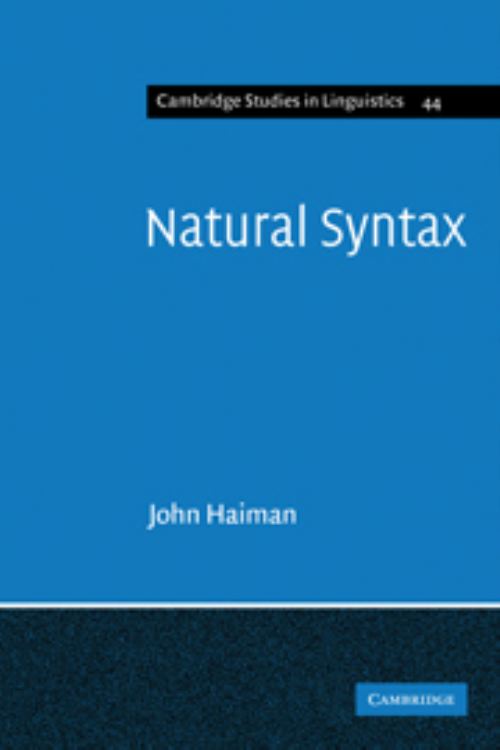
The view that language is in some way 'arbitrary', that there is no formal relationship between a linguistic message and the thought it is meant to convey, is long established and pervasive. The goal of John Haiman's study is to challenge the monopoly of arbitrariness, which he believes has affected in significant ways many models of linguistic description and analysis, notably those proposed by Saussure and more recently by Chomsky and his associates.
Linguistic structures, Dr Hainian claims, may be compared to (non-linguistic) diagrams of our thoughts, and deviate from iconicity in many of the same ways and for much the same reasons as do diagrams in general. Arbitrariness develops as a result of the relatively familiar principles of economy, generalization and association. In relation to this thesis, Dr Haiman considers a wide variety of constructions, including conditionals and interrogatives, gapping, causative structures, auxiliaries and reflexives, and provides a wealth of exemplification from different languages that also points to typological differences in respect of iconicity.
| ISBN: | 9780521266413 |
| Publication date: | 19th November 1985 |
| Author: | John Haiman |
| Publisher: | Cambridge University Press |
| Format: | Hardback |
| Pagination: | 285 pages |
| Series: | Cambridge Studies in Linguistics |
| Genres: |
Linguistics |
The view that language is in some way 'arbitrary', that there is no formal relationship between a linguistic message and the thought it is meant to convey, is long established and pervasive. The goal of John Haiman's study is to challenge the monopoly of arbitrariness, which he believes has affected in significant ways many models of linguistic description and analysis, notably those proposed by Saussure and more recently by Chomsky and his associates.
Natural Syntax features in the following genres: Linguistics
Hardback, Paperback. Not Available.
Natural Syntax was written by John Haiman and published by Cambridge University Press
Natural Syntax has 285 pages
Yes it is part of Cambridge Studies in Linguistics series