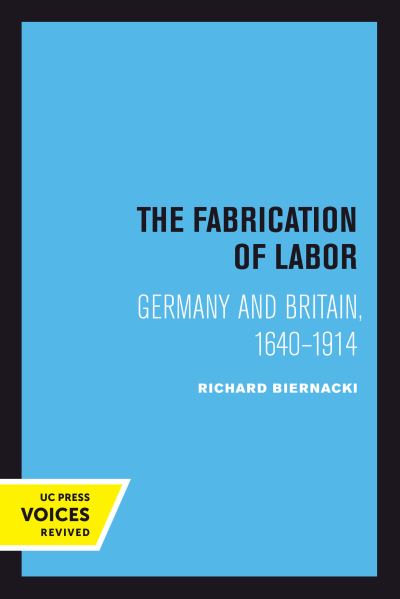
This monumental study demonstrates the power of culture to define the meaning of labor. Drawing on massive archival evidence from Britain and Germany, as well as historical evidence from France and Italy, The Fabrication of Labor shows how the very nature of labor as a commodity differed fundamentally in different national contexts. A detailed comparative study of German and British wool textile mills reveals a basic difference in the way labor was understood, even though these industries developed in the same period, used similar machines, and competed in similar markets. These divergent definitions of the essential character of labor as a commodity influenced the entire industrial phenomenon, affecting experiences of industrial work, methods of remuneration, disciplinary techniques, forms of collective action, and even industrial architecture. Starting from a rigorous analysis of detailed archival materials, this study broadens out to analyze the contrasting developmental pathways to wage labor in Western Europe and offers a startling reinterpretation of theories of political economy put forward by Adam Smith and Karl Marx. In his brilliant cross-national study, Richard Biernacki profoundly reorients the analysis of how culture constitutes the very categories of economic life.
This title is part of UC Press's Voices Revived program, which commemorates University of California Press's mission to seek out and cultivate the brightest minds and give them voice, reach, and impact. Drawing on a backlist dating to 1893, Voices Revived makes high-quality, peer-reviewed scholarship accessible once again using print-on-demand technology. This title was originally published in 1996.
Buy from our bookstore and 25% of the cover price will be given to a school of your choice to buy more books. *15% of eBooks.
Frequently asked questions
This monumental study demonstrates the power of culture to define the meaning of labor. Drawing on massive archival evidence from Britain and Germany, as well as historical evidence from France and Italy, The Fabrication of Labor shows how the very nature of labor as a commodity differed fundamentally in different national contexts. A detailed comparative study of German and British wool textile mills reveals a basic difference in the way labor was understood, even though these industries developed in the same period, used similar machines, and competed in similar markets. These divergent definitions of the essential character of labor as a commodity influenced the entire industrial phenomenon, affecting experiences of industrial work, methods of remuneration, disciplinary techniques, forms of collective action, and even industrial architecture. Starting from a rigorous analysis of detailed archival materials, this study broadens out to analyze the contrasting developmental pathways to wage labor in Western Europe and offers a startling reinterpretation of theories of political economy put forward by Adam Smith and Karl Marx. In his brilliant cross-national study, Richard Biernacki profoundly reorients the analysis of how culture constitutes the very categories of economic life.
This title is part of UC Press's Voices Revived program, which commemorates University of California Press's mission to seek out and cultivate the brightest minds and give them voice, reach, and impact. Drawing on a backlist dating to 1893, Voices Revived makes high-quality, peer-reviewed scholarship accessible once again using print-on-demand technology. This title was originally published in 1996.
The Fabrication of Labor features in the following genres: History
The Fabrication of Labor is available in Hardback, Paperback
The Fabrication of Labor was written by Richard Biernacki and published by University of California Press
Join our community for the latest bookish news, reading recommendations, exclusive opening extracts, author events and competitions. It\'s all free. And enter a monthly draw to win a £50 Gift Card. See past winners here