

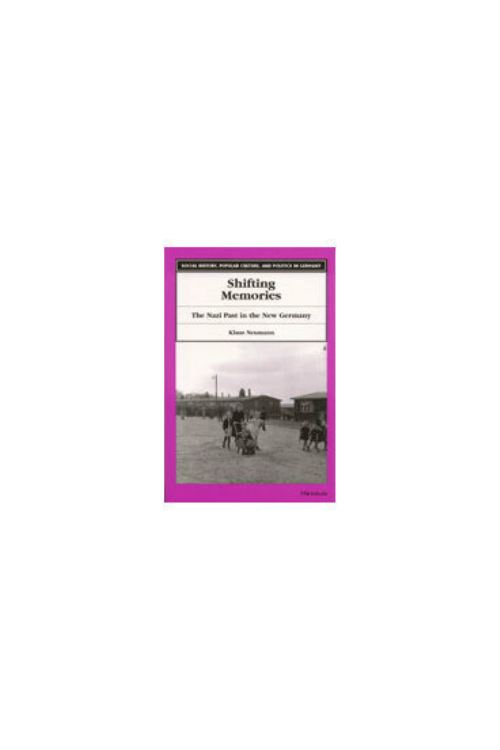
Shifting Memories explores the contours and genealogies of non-Jewish Germans' public memories of the Nazi past in the Federal Republic of Germany, asking how the crimes committed by Nazi Germany are reflected in the present. The study illuminates particular aspects of public remembering by focusing on case studies, telling a number of stories which at times appear parallel and at times intersect.
The case studies address, for example, the legacy of the so-called Celler Hasenjagd (the hunting down of concentration camp prisoners who survived an Allied air raid in April 1945 in a town in Lower Saxony); efforts by the City of Hildesheim to memorialize the Kristallnacht pogrom; attempts by Italian, Jewish, and Sinti survivors to commemorate their suffering in two West German towns; the posthumous reputation of a German communist imprisoned in Buchenwald and credited with having saved the lives of 159 Jewish children; and the public memories of the Ravensbrück and Buchenwald concentration camps in East Germany.
Directed at an audience curious about contemporary Germany, this book will appeal to those interested in issues of public and social memory, and in the legacy of Auschwitz.
Klaus Neumann is a historian who has taught in universities in Germany and Australia and written about social memories in the Pacific Islands, Australia, and Germany. Previous books include Not the Way It Really Was and Rabaul Yu Swit Moa Yet. He lives in Richmond, Australia.
| ISBN: | 9780472111473 |
| Publication date: | 22nd December 2000 |
| Author: | Klaus Neumann |
| Publisher: | The University of Michigan Press an imprint of University of Michigan Press |
| Format: | Hardback |
| Pagination: | 333 pages |
| Series: | Social History, Popular Culture, and Politics in Germany |
| Genres: |
History Popular culture Ethnic studies The arts: general topics |
Shifting Memories explores the contours and genealogies of non-Jewish Germans' public memories of the Nazi past in the Federal Republic of Germany, asking how the crimes committed by Nazi Germany are reflected in the present. The study illuminates particular aspects of public remembering by focusing on case studies, telling a number of stories which at times appear parallel and at times intersect.The case studies address, for example, the legacy of the so-called Celler Hasenjagd (the hunting down of concentration camp prisoners who survived an Allied air raid in April 1945 in a town in Lower Saxony); efforts by the City of Hildesheim to memorialize the Kristallnacht pogrom; attempts by Italian, Jewish, and Sinti survivors to commemorate their suffering in two West German towns; the posthumous reputation of a German communist imprisoned in Buchenwald and credited with having saved the lives of 159 Jewish children; and the public memories of the Ravensbrück and Buchenwald concentration camps in East Germany.Directed at an audience curious about contemporary Germany, this book will appeal to those interested in issues of public and social memory, and in the legacy of Auschwitz.Klaus Neumann is a historian who has taught in universities in Germany and Australia and written about social memories in the Pacific Islands, Australia, and Germany.
Shifting Memories features in the following genres: History, Popular culture, Ethnic studies, The arts: general topics
Hardback, Paperback. Not Available.
Shifting Memories was written by Klaus Neumann and published by The University of Michigan Press an imprint of University of Michigan Press
Shifting Memories has 333 pages
Yes it is part of Social History, Popular Culture, and Politics in Germany series