

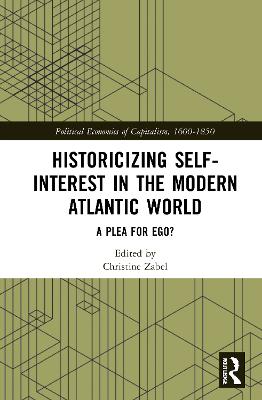
This volume historicizes the use of the notion of self-interest that at least since Bernard de Mandeville and Adam Smith’s theories is considered a central component of economic theory. Having in the twentieth century become one of the key-features of rational choice models, and thus is seen as an idealized trait of human behavior, self-interest has, despite Albert O. Hirschman’s pivotal analysis of self-interest, only marginally been historicized. A historicization(s) of self-interest, however, offers new insights into the concept by asking why, when, for what reason and in which contexts the notion was discussed or referred to, how it was employed by contemporaries, and how the different usages developed and changed over time. This helps us to appreciate the various transformations in the perception of the notion, and also to explore how and in what ways different people at different times and in different regions reflected on or realized the act of considering what was in their best interest. The volume focuses on those different usages, knowledges, and practices concerned with self-interest in the modern Atlantic World from the seventeenth to twentieth centuries, by using different approaches, including political and economic theory, actuarial science, anthropology, or the history of emotions. Offering a new perspective on a key component of Western capitalism, this is the ideal resource for researches and scholars of intellectual, political and economic history in the modern Atlantic World.
| ISBN: | 9780367741495 |
| Publication date: | 26th September 2022 |
| Author: | Christine Zabel |
| Publisher: | Routledge an imprint of Taylor & Francis Ltd |
| Format: | Paperback |
| Pagination: | 292 pages |
| Series: | Political Economies of Capitalism, 1600-1850 |
| Genres: |
Historiography Economic theory and philosophy Economic history Political economy |
This volume historicizes the use of the notion of self-interest that at least since Bernard de Mandeville and Adam Smith’s theories is considered a central component of economic theory. Having in the twentieth century become one of the key-features of rational choice models, and thus is seen as an idealized trait of human behavior, self-interest has, despite Albert O. Hirschman’s pivotal analysis of self-interest, only marginally been historicized. A historicization(s) of self-interest, however, offers new insights into the concept by asking why, when, for what reason and in which contexts the notion was discussed or referred to, how it was employed by contemporaries, and how the different usages developed and changed over time. This helps us to appreciate the various transformations in the perception of the notion, and also to explore how and in what ways different people at different times and in different regions reflected on or realized the act of considering what was in their best interest. The volume focuses on those different usages, knowledges, and practices concerned with self-interest in the modern Atlantic World from the seventeenth to twentieth centuries, by using different approaches, including political and economic theory, actuarial science, anthropology, or the history of emotions. Offering a new perspective on a key component of Western capitalism, this is the ideal resource for researches and scholars of intellectual, political and economic history in the modern Atlantic World.
Historicizing Self-Interest in the Modern Atlantic World features in the following genres: Historiography, Economic theory and philosophy, Economic history, Political economy
Historicizing Self-Interest in the Modern Atlantic World is available in Paperback, Hardback
Historicizing Self-Interest in the Modern Atlantic World was written by Christine Zabel and published by Routledge an imprint of Taylor & Francis Ltd
Historicizing Self-Interest in the Modern Atlantic World has 292 pages
Yes it is part of Political Economies of Capitalism, 1600-1850 series
£41.39