

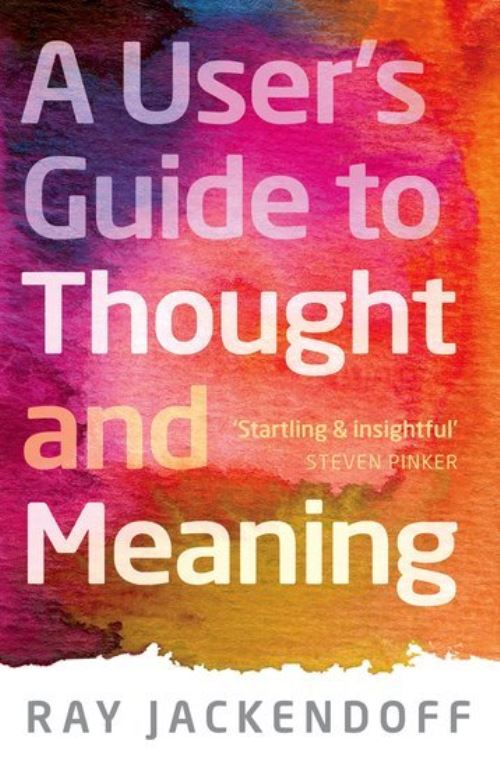
A User's Guide to Thought and Meaning presents a profound and arresting integration of the faculties of the mind - of how we think, speak, and see the world. Ray Jackendoff starts out by looking at languages and what the meanings of words and sentences actually do. He shows that meanings are more adaptive and complicated than they're commonly given credit for, and he is led to some basic questions: How do we perceive and act in the world?
How do we talk about it? And how can the collection of neurons in the brain give rise to conscious experience? As it turns out, the organization of language, thought, and perception does not look much like the way we experience things, and only a small part of what the brain does is conscious.
Jackendoff concludes that thought and meaning must be almost completely unconscious. What we experience as rational conscious thought - which we prize as setting us apart from the animals - in fact rides on a foundation of unconscious intuition. Rationality amounts to intuition enhanced by language.
Written with an informality that belies both the originality of its insights and the radical nature of its conclusions, A User's Guide to Thought and Meaning is the author's most important book since the groundbreaking Foundations of Language in 2002.
| ISBN: | 9780199693207 |
| Publication date: | 23rd February 2012 |
| Author: | Ray Jackendoff |
| Illustrator: | Neil Cohn, Bill Griffith |
| Publisher: | Oxford University Press an imprint of OUP OXFORD |
| Format: | Hardback |
| Pagination: | 288 pages |
| Genres: |
Cognitivism, cognitive theory Neurosciences Philosophy of mind Philosophy of language Psycholinguistics and cognitive linguistics |
A User's Guide to Thought and Meaning presents a profound and arresting integration of the faculties of the mind - of how we think, speak, and see the world. Ray Jackendoff starts out by looking at languages and what the meanings of words and sentences actually do.
A User's Guide to Thought and Meaning features in the following genres: Cognitivism, cognitive theory, Neurosciences, Philosophy of mind, Philosophy of language, Psycholinguistics and cognitive linguistics
Hardback. £19.79, down from the £21.99 cover price. Print on Demand / Special Order.
A User's Guide to Thought and Meaning was written by Ray Jackendoff and published by Oxford University Press an imprint of OUP OXFORD
A User's Guide to Thought and Meaning has 288 pages
£19.79, reduced from £21.99. Print on Demand / Special Order.