

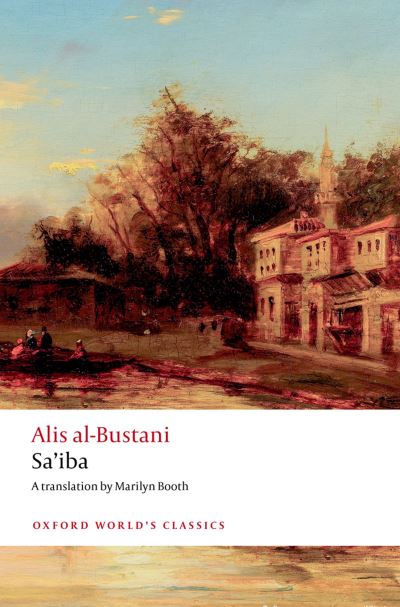
'Let us go on, then! And I will tell you the story of my sister and her daughter, from beginning to end.' Alis al-Bustani's Sa'iba (1891) is one of the earliest known novels authored in Arabic by a female writer. Written when the Arabic novel was only in its third or fourth decade, it takes up the leading fictional theme of the era: the question of young people's choices in marriage in a society where their elders traditionally made these decisions. In Sa'iba, the focus is on what happens after the wedding, as the eponymous heroine has to fend off a jealous cousin who believes he has a right to her. Drawing on motifs of Victorian Gothic writing, brought into an Arab-Turkish fictional context, the novel powerfully shows the continuing hold of old ideas about women's sexual susceptibility and moral 'weakness', as such ideas were slowly giving way among educated Arab and other Ottoman middle classes to new ideals of companionship in marriage. Marilyn Booth's translation is accompanied by an introduction discussing the themes and social context of the novel, a time of modernizing efforts and pushback against European and American power and culture in the Arabic and Ottman worlds. ABOUT THE SERIES: For over 100 years Oxford World's Classics has made available the widest range of literature from around the globe. Each affordable volume reflects Oxford's commitment to scholarship, providing the most accurate text plus a wealth of other valuable features, including expert introductions by leading authorities, helpful notes to clarify the text, up-to-date bibliographies for further study, and much more.
| ISBN: | 9780198921684 |
| Publication date: | 12th March 2026 |
| Author: | Alis AlBustani |
| Publisher: | Oxford University Press an imprint of OUP OXFORD |
| Format: | Paperback |
| Pagination: | 176 pages |
| Series: | Oxford World's Classics |
| Genres: |
Literary studies: c 1800 to c 1900 Literary studies: fiction, novelists and prose writers Classic fiction: general and literary |
'Let us go on, then! And I will tell you the story of my sister and her daughter, from beginning to end.' Alis al-Bustani's Sa'iba (1891) is one of the earliest known novels authored in Arabic by a female writer. Written when the Arabic novel was only in its third or fourth decade, it takes up the leading fictional theme of the era: the question of young people's choices in marriage in a society where their elders traditionally made these decisions. In Sa'iba, the focus is on what happens after the wedding, as the eponymous heroine has to fend off a jealous cousin who believes he has a right to her. Drawing on motifs of Victorian Gothic writing, brought into an Arab-Turkish fictional context, the novel powerfully shows the continuing hold of old ideas about women's sexual susceptibility and moral 'weakness', as such ideas were slowly giving way among educated Arab and other Ottoman middle classes to new ideals of companionship in marriage. Marilyn Booth's translation is accompanied by an introduction discussing the themes and social context of the novel, a time of modernizing efforts and pushback against European and American power and culture in the Arabic and Ottman worlds. ABOUT THE SERIES: For over 100 years Oxford World's Classics has made available the widest range of literature from around the globe. Each affordable volume reflects Oxford's commitment to scholarship, providing the most accurate text plus a wealth of other valuable features, including expert introductions by leading authorities, helpful notes to clarify the text, up-to-date bibliographies for further study, and much more.
Sa'iba features in the following genres: Literary studies: c 1800 to c 1900, Literary studies: fiction, novelists and prose writers, Classic fiction: general and literary
Sa'iba is available in Paperback
Sa'iba was written by Alis AlBustani and published by Oxford University Press an imprint of OUP OXFORD
Sa'iba has 176 pages
Yes it is part of Oxford World's Classics series
£7.19