

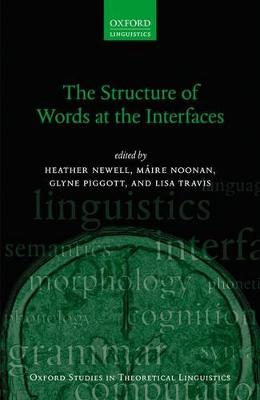
This volume takes a variety of approaches to the question 'what is a word?', with particular emphasis on where in the grammar wordhood is determined. Chapters in the book all start from the assumption that structures at, above, and below the 'word' are built in the same derivational system: there is no lexicalist grammatical subsystem dedicated to word-building. This type of framework foregrounds the difficulty in defining wordhood. Questions such as whether there are restrictions on the size of structures that distinguish words from phrases, or whether there are combinatory operations that are specific to one or the other, are central to the debate. In this respect, chapters in the volume do not all agree. Some propose wordhood to be limited to entities defined by syntactic heads, while others propose that phrasal structure can be found within words. Some propose that head-movement and adjunction (and Morphological Merger, as its mirror image) are the manner in which words are built, while others propose that phrasal movements are crucial to determining the order of morphemes word-internally. All chapters point to the conclusion that the phonological domains that we call words are read off of the morphosyntactic structure in particular ways. It is the study of this interface, between the syntactic and phonological modules of Universal Grammar, that underpins the discussion in this volume.
| ISBN: | 9780198778264 |
| Publication date: | 11th May 2017 |
| Author: | Heather Assistant Professor, Assistant Professor, Linguistics Dept, Université du Québec à Montréal Newell |
| Publisher: | Oxford University Press |
| Format: | Hardback |
| Pagination: | 382 pages |
| Series: | Oxford Studies in Theoretical Linguistics |
| Genres: |
Grammar, syntax and morphology Phonetics, phonology |
This volume takes a variety of approaches to the question 'what is a word?', with particular emphasis on where in the grammar wordhood is determined. Chapters in the book all start from the assumption that structures at, above, and below the 'word' are built in the same derivational system: there is no lexicalist grammatical subsystem dedicated to word-building. This type of framework foregrounds the difficulty in defining wordhood. Questions such as whether there are restrictions on the size of structures that distinguish words from phrases, or whether there are combinatory operations that are specific to one or the other, are central to the debate. In this respect, chapters in the volume do not all agree. Some propose wordhood to be limited to entities defined by syntactic heads, while others propose that phrasal structure can be found within words. Some propose that head-movement and adjunction (and Morphological Merger, as its mirror image) are the manner in which words are built, while others propose that phrasal movements are crucial to determining the order of morphemes word-internally. All chapters point to the conclusion that the phonological domains that we call words are read off of the morphosyntactic structure in particular ways. It is the study of this interface, between the syntactic and phonological modules of Universal Grammar, that underpins the discussion in this volume.
The Structure of Words at the Interfaces features in the following genres: Grammar, syntax and morphology, Phonetics, phonology
The Structure of Words at the Interfaces is available in Hardback, Paperback
The Structure of Words at the Interfaces was written by Heather Assistant Professor, Assistant Professor, Linguistics Dept, Université du Québec à Montréal Newell and published by Oxford University Press
The Structure of Words at the Interfaces has 382 pages
Yes it is part of Oxford Studies in Theoretical Linguistics series
£112.50