

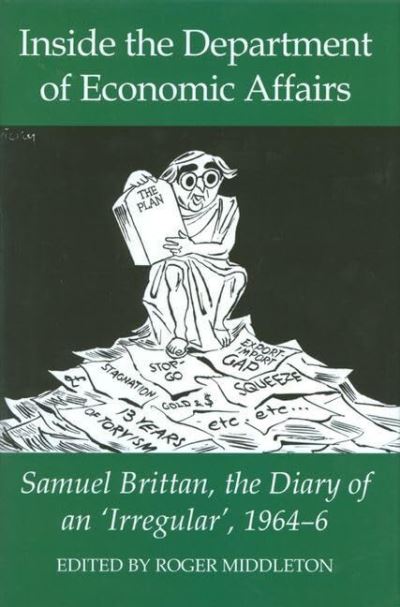
The rise and fall of the Department of Economic Affairs (DEA) parallels the promised but eventually unfulfilled modernization agenda of the 1964-6 Wilson government. The diary kept by Samuel Brittan (in contravention of civil service rules) for the fourteen months in which he served as an 'irregular' in the DEA provides a unique source for understanding the growth ambitions of the new government and why they quickly ran into the sands. Published here in full, with extensive notes, the diary sheds light on the Wilson government more broadly, giving insights into the 'great reappraisal' of economic policy, the reform of government institutions and the personalities of those involved.
Samuel Brittan emerged as the most important economic journalist of his generation (at the Financial Times from 1955, with brief interruptions, to the present). His diary is would be of interest for that reason alone, but it has a double value because of the special place that his book, The Treasury under the Tories, 1951-64, has in diagnoses of successive failures in postwar British economic policy. The diary is central to understanding why Brittan turned against 1960s dirigisme and thus constitutes an important contribution to the early intellectual history of the reaction against the postwar consensus.
| ISBN: | 9780197265000 |
| Publication date: | 12th April 2012 |
| Author: | Samuel Brittan, Roger Middleton |
| Publisher: | The British Academy an imprint of Liverpool University Press |
| Format: | Hardback |
| Pagination: | 229 pages |
| Series: | Records of Social and Economic History. New Series |
| Genres: |
Central / national / federal government policies Political economy Economic history |
The rise and fall of the Department of Economic Affairs (DEA) parallels the promised but eventually unfulfilled modernization agenda of the 1964-6 Wilson government. The diary kept by Samuel Brittan (in contravention of civil service rules) for the fourteen months in which he served as an 'irregular' in the DEA provides a unique source for understanding the growth ambitions of the new government and why they quickly ran into the sands. Published here in full, with extensive notes, the diary sheds light on the Wilson government more broadly, giving insights into the 'great reappraisal' of economic policy, the reform of government institutions and the personalities of those involved.
Samuel Brittan emerged as the most important economic journalist of his generation (at the Financial Times from 1955, with brief interruptions, to the present). His diary is would be of interest for that reason alone, but it has a double value because of the special place that his book, The Treasury under the Tories, 1951-64, has in diagnoses of successive failures in postwar British economic policy. The diary is central to understanding why Brittan turned against 1960s dirigisme and thus constitutes an important contribution to the early intellectual history of the reaction against the postwar consensus.
Inside the Department of Economic Affairs features in the following genres: Central / national / federal government policies, Political economy, Economic history
Inside the Department of Economic Affairs is available in Hardback
Inside the Department of Economic Affairs was written by Samuel Brittan, Roger Middleton and published by The British Academy an imprint of Liverpool University Press
Inside the Department of Economic Affairs has 229 pages
Yes it is part of Records of Social and Economic History. New Series series