

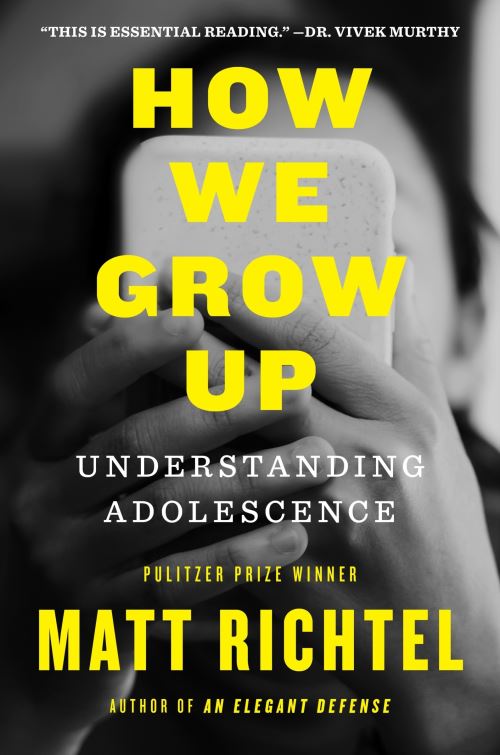
"This is essential reading for parents." — Dr. Vivek Murthy, former U.S. Surgeon General
Greatly expanding his award-winning New York Times series on the contemporary teen mental-health crisis, Pulitzer Prize–winning science reporter Matt Richtel delivers a groundbreaking investigation into the psychology of adolescence, the pivotal life stage undergoing profound—and often confounding—transformation.
One of The New Yorker's Best Books of 2025
The transition from childhood to adulthood is a natural, evolution-honed cycle that now faces radical change and challenge. The adolescent brain, sculpted for this transition over eons of evolution, confronts a modern world that creates so much social pressure as to regularly exceed the capacities of the evolving mind.
The problem comes as a bombardment of screen-based information pelts the brain just as adolescence is undergoing a second key change: puberty is hitting earlier. The result is a neurological mismatch between an ultra-potent environment and a still-maturing brain that can lead to anxiety and depression in teens and other mental health challenges.
It is a crisis that is part of modern life but can only be truly grasped through the broad, grounded lens of the science of adolescence itself. Through this lens, Richtel shows us how adolescents can understand themselves, and parents and educators can better help.
For decades, this transition to adulthood has been defined by hormonal shifts that trigger the onset of puberty. But Richtel takes us where science now understands so much of the action is: the fascinating topic of adolescent brain development. A growing body of research that looks for the first time into budding adult neurobiology explains with untold clarity the emergence of the “social brain,” a craving for peer connection, and how the behaviors that follow pave the way for economic and social survival.
This period necessarily involves testing—as the adolescent brain is programmed from birth to take risks and explore themselves and their environment—so that they may be able to thrive as they leave the insulated care of childhood.
Richtel, diving deeply into new research and gripping personal stories, offers accessible, scientifically grounded answers to the most pressing questions about generational change. What explains adolescent behaviors, risk-taking, reward-seeking, and the ongoing mental health crisis? How does adolescence shape the future of the species? What is the nature of adolescence itself?
| ISBN: | 9780063282063 |
| Publication date: | 28th August 2025 |
| Author: | Matt Richtel |
| Publisher: | Mariner Books an imprint of HarperCollins |
| Format: | Hardback |
| Pagination: | 336 pages |
| Genres: |
Age groups: children Age groups: adolescents Teenagers: advice for parents Neurosciences Cognitivism, cognitive theory Child, developmental and lifespan psychology Physiological and neuro-psychology, biopsychology Cognition and cognitive psychology Educational psychology Parenting Psychology |
"This is essential reading for parents." — Dr. Vivek Murthy, former U.S.
How We Grow Up features in the following genres: Age groups: children, Age groups: adolescents, Teenagers: advice for parents, Neurosciences, Cognitivism, cognitive theory, Child, developmental and lifespan psychology, Physiological and neuro-psychology, biopsychology, Cognition and cognitive psychology, Educational psychology, Parenting, Psychology
Paperback, Hardback. £22.50, down from the £25.00 cover price. In Stock.
How We Grow Up was written by Matt Richtel and published by Mariner Books an imprint of HarperCollins
How We Grow Up has 336 pages
£22.50, reduced from £25.00. In Stock.