Browse audiobooks narrated by Zacharias Prewett, listen to samples and when you're ready head over to Audiobooks.com where you can get 3 FREE audiobooks on us
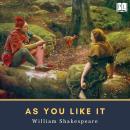
"In a French duchy, the old Duke has been usurped by his younger brother, Frederick. A young man named Orlando is mistreated by his elder brother, against their dead father's wishes. Rosalind, the old Duke's daughter, has been allowed to remain in court only because she is the closest friend of Celia, Duke Frederick's daughter. When Rosalind is banished from court, she flees to the Forest of Arden with Celia and Touchstone, the court fool; meanwhile, Orlando also escapes to the forest, fleeing his brother. In the Forest of Arden, the old Duke holds court with exiled supporters, including the melancholy Jaques. There, Rosalind disguises herself as Ganymede and offers advice to a group of would-be lovers: Orlando, who has taken to posting love poems dedicated to Rosalind on trees, and Silvius and Phebe, two young shepherds. Shakespeare is thought to have written As You Like It around 1599; while stylistic analysis has not conclusively established its place in the canon, it was certainly completed by August 1600 and was published in the First Folio in 1623. There are no certain dates of performance until the 17th century, but it may have been performed in 1599 or 1603. The play includes a number of Shakespeare's most famous speeches, including Jaques' monologue, 'All the world's a stage.'"
William Shakespeare (Author), Susan Bones, Zacharias Prewett (Narrator)
Audiobook
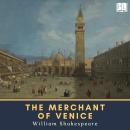
"The young venetian noble Bassanio seeks to woo the beautiful heiress Portia of Belmont. He turns to his friend, a merchant named Antonio, who agrees to help him financially. They go to a Jewish moneylender, Shylock, who agrees to lend the money - but because of their mutual animosity, Shylock demands 'A pound of flesh' from Antonio as collateral. Bassanio succeeds in winning Portia's hand. Meanwhile, Antonio's ships are reported lost at sea, and he defaults on the loan. Bassanio rushes back to Venice to help his benefactor where everything comes to a head in Court."
William Shakespeare (Author), Susan Bones, Zacharias Prewett (Narrator)
Audiobook
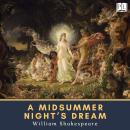
"A Midsummer Night's Dream is one of the many comedies written by William Shakespeare. It was written around 1595 and first published in Shakespeare's first quarto in 1600. The exact reason for why this play was produced has been lost to time; some historians theorize that it could have been written for an aristocratic wedding, or for Queen Elizabeth I to celebrate the feast of St. John. The play opens with Theseus, Duke of Athens, and Hippolyta, Queen of the Amazons, planning the celebration of their marriage. During their visit to Athens four guests - Demetrius, Lysander, Helena, and Hermia - are trying to find their own spouses and to follow each other into the woods. Also entering the woods are six actors practicing a play for the duke and his new wife. Unbeknownst to all, they have also entered the realm of the fairy kingdom, ruled by King Oberon and Queen Titania and inhabited by the mischievous Puck."
William Shakespeare (Author), Susan Bones, Zacharias Prewett (Narrator)
Audiobook
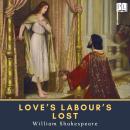
"King Ferdinand and his three friends, Biron, Longaville, and Dumain, plan to study philosophy for the next three years. During their academic pursuits, they must vow to sleep only three hours a night and not let any woman within a mile of court. These strict rules will prevent any distractions from their work - but their promises are soon put to the test when a princess and her three companions arrive for a state visit."
William Shakespeare (Author), Susan Bones, Zacharias Prewett (Narrator)
Audiobook
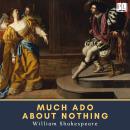
"Shakespeare wrote Much Ado About Nothing towards the middle of his career, sometime between 1598 and 1599. It was first published in quarto in 1600 and later collected into Mr. William Shakespeare's Comedies, Histories, and Tragedies in 1623. The earliest recorded performance of Much Ado About Nothing was performed for the newly-married Princess Elizabeth and Frederick the Fifth, Elector Palatine in 1613. Shakespeare's sources of inspiration for this play can be found in Italian culture and popular texts published in the sixteenth century. Gossip involving lovers deceived into believing each other false was often spread throughout Northern Italy. Works like Ludovico Ariosto's Orlando Furioso and Edmund Spencer's Fearie Queene also feature tricked lovers like Claudio and Hero. Besides these similarities, the idea of tricking a couple like Benedick and Beatrice into falling in love was an original and unusual idea at the time. The play focuses on two couples: upon the noblemen's return to Messina, Claudio and Hero quickly fall in love and wish to marry in a week; on the contrary, Benedick and Beatrice resume their verbal war, exchanging insults with each other. To pass the time prior to the marriage a plot to trick Benedick and Beatrice into falling in love has been set in motion. Unbeknownst to both our couples, a fouler plot to crush the love and happiness between Hero and Claudio has also begun to unfold."
William Shakespeare (Author), Susan Bones, Zacharias Prewett (Narrator)
Audiobook
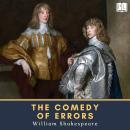
"The Comedy of Errors is one of Shakespeare's earliest and shortest plays. This comedy utilizes slapstick humor, word play, and mistaken identities to create a series of farcical accidents. Over time, the play's title has become an idiom used to describe 'an event or series of events made ridiculous by the number of errors that were made throughout.' In Ephesus, the law forbids entry to any merchants from Syracuse, and if they are discovered within the city, they must pay a thousand marks or be put to death. Aegeon, an old Syracusian merchant, is arrested and Solinus, the Duke of Ephesus, listens to his story of coming to the city. Long ago, Aegeon was on a sea voyage. Traveling with him was his wife, his twin sons, and their twin slaves. The family becomes separated during a tempest; Aegeon, one son, and one slave were rescued together, and the others were never to be seen again. Years later his son Antipholus and his slave Dromio left to search for their long lost siblings; after the boys didn't return, Aegeon set out to bring his son back home. Moved by this story, the duke allows Aegeon one day to get the money to pay his fine and to find his family."
William Shakespeare (Author), Susan Bones, Zacharias Prewett (Narrator)
Audiobook
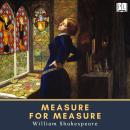
"Duke Vincentio has given his deputy Angelo temporary power over Vienna before his leave for a diplomatic mission. But instead of leaving the city, the Duke disguises himself as a friar named Lodowick, and stays behind to observe the city's happenings and Angelo's brief reign. Meanwhile, Angelo decides to enforce the laws on prostitution and debauchery, effectively shutting down the red-light district. A man named Claudio gets arrested for impregnating his lover, and Angelo sentences him to death. Claudio's sister enlists a certain friar's help to trick Angelo into releasing her brother."
William Shakespeare (Author), Susan Bones, Zacharias Prewett (Narrator)
Audiobook
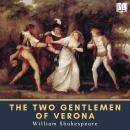
"Two close friends, Proteus and Valentine, are saying their goodbyes in the streets of Verona. Valentine plans to travel to Milan and discover the world, but Proteus wants to stay with Julia, a woman he loves. While in Milan, Valentine falls in love with the duke's daughter, Sylvia, and plans to elope with her. Antonio, Proteus' father, later orders his son to join Valentine in Milan. Before leaving, Proteus exchanges rings and vows of undying love with Julia. When Proteus enters the aristocratic courts of Milan, he instantly falls in love with Sylia and forgets all about Julia. The love triangle between Sylvia, Proteus, and Valentine will test the loyalty of friendship."
William Shakespeare (Author), Susan Bones, Zacharias Prewett (Narrator)
Audiobook
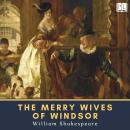
"First published in 1602 by William Shakespeare, The Merry Wives of Windsor features the popular figure Sir John Falstaff, who first appeared in Henry IV, Part 1 and Part 2. Some speculate that Merry Wives was written at the behest of Queen Elizabeth I, who wanted to see Falstaff in love; and that Shakespeare was forced to rush its creation as a result, and so it remains one of Shakespeare's lesser-regarded plays. The play revolves around two intertwined plots: the adventures of the rogue Falstaff who plans to seduce several local wives, and the story of young Anne Page who is being wooed by prominent citizens while she has her sights set on young Fenton. The wives come together to teach Falstaff a lesson, and in the end love triumphs. The Merry Wives of Windsor is believed to have been first performed in 1597 and was subsequently published in quarto in 1602, in a second quarto in 1619, and then in the 1623 First Folio. Despite holding a lesser place in Shakespeare's canon, it was one of the first Shakespearean plays to be performed in 1660, after the reinstatement of Charles II and theatre once again was permitted to be performed in London."
William Shakespeare (Author), Susan Bones, Zacharias Prewett (Narrator)
Audiobook
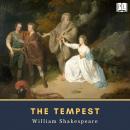
"The Tempest is a play by English playwright William Shakespeare, probably written in 1610-1611, and thought to be one of the last plays that Shakespeare wrote alone. After the first scene, which takes place on a ship at sea during a tempest, the rest of the story is set on a remote island, where the sorcerer Prospero, a complex and contradictory character, lives with his daughter Miranda, and his two servants: Caliban, a savage monster figure, and Ariel, an airy spirit. The play contains music and songs that evoke the spirit of enchantment on the island. It explores many themes, including magic, betrayal, revenge, and family. In Act IV, a wedding masque serves as a play-within-a-play, and contributes spectacle, allegory, and elevated language. Although The Tempest is listed in the First Folio as the first of Shakespeare's comedies, it deals with both tragic and comic themes, and modern criticism has created a category of romance for this and others of Shakespeare's late plays. The Tempest has been put to varied interpretations, from those that see it as a fable of art and creation, with Prospero representing Shakespeare, and Prospero's renunciation of magic signaling Shakespeare's farewell to the stage, to interpretations that consider it an allegory of Europeans colonizing foreign lands."
William Shakespeare (Author), Susan Bones, Zacharias Prewett (Narrator)
Audiobook
"The collection Poems: Series One presents the first installment of the complete poetic works of Emily Dickinson. It is broken into the four parts Life, Love, Nature, and Time and Eternity and includes 115 poems. Emily Elizabeth Dickinson (December 10, 1830 - May 15, 1886) was an American poet. Little-known during her life, she has since been regarded as one of the most important figures in American poetry. Dickinson was born in Amherst, Massachusetts, into a prominent family with strong ties to its community. After studying at the Amherst Academy for seven years in her youth, she briefly attended the Mount Holyoke Female Seminary before returning to her family's house in Amherst. Evidence suggests that Dickinson lived much of her life in isolation. Considered an eccentric by locals, she developed a penchant for white clothing and was known for her reluctance to greet guests or, later in life, to even leave her bedroom. Dickinson never married, and most friendships between her and others depended entirely upon correspondence. While Dickinson was a prolific writer, her only publications during her lifetime were 10 of her nearly 1,800 poems, and one letter. The poems published then were usually edited significantly to fit conventional poetic rules. Her poems were unique for her era. They contain short lines, typically lack titles, and often use slant rhyme as well as unconventional capitalization and punctuation. Many of her poems deal with themes of death and immortality, two recurring topics in letters to her friends, and also explore aesthetics, society, nature and spirituality. Although Dickinson's acquaintances were most likely aware of her writing, it was not until after her death in 1886 - when Lavinia, Dickinson's younger sister, discovered her cache of poems - that her work became public. Her first collection of poetry was published in 1890 by personal acquaintances Thomas Wentworth Higginson and Mabel Loomis Todd, though both heavily edited the content. A 1998 article in The New York Times revealed that of the many edits made to Dickinson's work, the name Susan was often deliberately removed. At least eleven of Dickinson's poems were dedicated to sister-in-law Susan Huntington Gilbert Dickinson, though all the dedications were obliterated, presumably by Todd. A complete, and mostly unaltered, collection of her poetry became available for the first time when scholar Thomas H. Johnson published The Poems of Emily Dickinson in 1955."
Emily Dickinson (Author), Zacharias Prewett (Narrator)
Audiobook
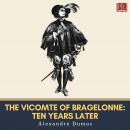
The Vicomte of Bragelonne: Ten Years Later
"The Vicomte of Bragelonne: Ten Years Later (French: Le Vicomte de Bragelonne ou Dix ans plus tard) is a novel by Alexandre Dumas. It is the third and last of The d'Artagnan Romances, following The Three Musketeers and Twenty Years After. It appeared first in serial form between 1847 and 1850. In the English translations, the chapters of this large volume are usually subdivided four individual books: 1. The Vicomte de Bragelonne 2. Ten Years Later 3. Louise de la Vallière 4. The Man in the Iron Mask Set in the 1660s and concerned with the early reign of Louis XIV, the novel has been called an 'origins' story of the King, 'a tale about the education of a young man who went on to rule for over 70 years and become one of France's most beloved monarchs'. Naturally, in a novel about Dumas' musketeers, the characters play an important role in Louis' education."
Alexandre Dumas (Author), Susan Bones, Zacharias Prewett (Narrator)
Audiobook

©PTC International Ltd T/A LoveReading is registered in England. Company number: 10193437. VAT number: 270 4538 09. Registered address: 157 Shooters Hill, London, SE18 3HP.
Terms & Conditions | Privacy Policy | Disclaimer
Join our community for the latest bookish news, reading recommendations, exclusive opening extracts, author events and competitions. It\'s all free. And enter a monthly draw to win a £50 Gift Card. See past winners here
Join Our Community