Browse audiobooks narrated by Sue Anderson, listen to samples and when you're ready head over to Audiobooks.com where you can get 3 FREE audiobooks on us
"Fortress-walled Saint Catherine's monastery on the Sinai Peninsula (Egypt) has been a pilgrimage site since its founding by the Byzantine Emperor Justinian in the 6th century. According to tradition, the monastery sits at the base of the mountain where Moses received the Tablets of the Law. Set in rugged country, it was for a very long time only accessible through a long camel-back journey across the barren desert. The monastery survived intact through the centuries, and as a result became a rich repository of religious history: icons, mosaics, books and manuscripts have been preserved through the ages in the monastery’s library. 'Our Journey to Sinai' by Agnes Bensly is the story of a visit to Saint Catherine's by a group of British scholars in the 1890's, who were drawn there in their quest for early Christian manuscripts. They were looking for a second century translation of the Gospels from the Greek into an Aramaic dialect called Syriac, a very rare and precious document. One of the group’s members, Agnes Smith Lewis, an accomplished linguist, has been to the monastery once before. During that visit, she had spotted a 'palimpsest of most venerable appearance.' Smith Lewis had recognized the hidden underwriting in this book to be in Syriac, 'the native language of Our Lord and His disciples.' This is the reason why the group has now decided to revisit Saint Catherine's, in the hope of finding and copying that ancient text. Their trip is vividly described by Agnes Bensly, portraying bustling Cairo, Bedouins crossing the desert with their camels, the monks and monastery life of Saint Catherine, the breathtaking climb up the 3000 stone steps to the top of Mount Sinai, and what they found in the mysterious manuscript they had come so far to see. 'Our Journey to Sinai' is a wonderful travel book and an intimate portrait of Saint Catherine's monastery, a monastery which is today a World Heritage Site. - Agnes Dorothea Bensly (born Von Blomberg), was born in 1834 in Postdam, Prussia (current Germany). The daughter of Baron Eduard von Blomberg, she married the Orientalist and biblical scholar Robert Lubbock Bensly (1831-93) in 1860. The Cambridge man had been studying Syriac in Bonn and Halle. He made two short visits to Egypt and Sinai but died a few days after his return from his last trip. Agnes lost her sight shortly after, but she wanted to have his work published, and as such, wrote 'A Journey to Sinai' in braille. She passed away on the 22nd December 1900, in England."
Agnes Bensly (Author), Sue Anderson (Narrator)
Audiobook
"An intensely personal account of the immigration experience as related by a young Jewish girl from Plotzk (a town in the government of Vitebsk, Russia). Mary Antin, with her mother, sisters, and brother, set out from Plotzk in 1894 to join their father, who had journeyed to the "Promised Land" of America three years before. Fourth class railroad cars packed to suffocation, corrupt crossing guards, luggage and persons crudely "disinfected" by German officials who feared the cholera, locked "quarantine" portside, and, finally, the steamer voyage and a famiily reunited. For anyone who has ever wondered what it was like for their grandparents or great grandparents to emmigrate from Europe to the United States last century, this is a fascinating narrative. Mary Antin went on to become an immigration rights activist. She also wrote an autobiography, The Promised Land, published in 1912, which detailed her assimilation into American culture. (Summary by Sue Anderson)"
Mary Antin (Author), Sue Anderson (Narrator)
Audiobook
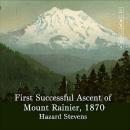
First Successful Ascent of Mt. Rainier, 1870
"Hazard Stevens and P.B. Van Trump, aided by the Indian guide Sluiskin, made the first documented successful ascent of Mt. Rainier on August 17, 1870. Hazard's account of the climb was first published in the Atlantic Monthly in 1876 and later reprinted with an introduction by Edmond S. Meany in 1916. Sluiskin tried to dissuade the climbers. "Takhoma” (the Indian name for Mt. Rainier) "was an enchanted mountain, inhabited by an evil spirit, who dwelt in a fiery lake on its summit. No human being could ascend it or even attempt its ascent and survive." This prophecy almost proved true. Thinking they could reach the summit and return on the same day, Stevens and Van Trump left behind coats and blankets, only to find themselves trapped overnight in bitter cold. They survived huddled around a volcanic steam vent in an ice cave. "The heat at the orifice was too great to bear for more than an instant, but the steam wet us, the smell of sulfur was nauseating, and the cold was so severe that our clothes, saturated with the steam, froze stiff when turned away from the heated jet." (Summary by Sue Anderson)"
Hazard Stevens (Author), Sue Anderson (Narrator)
Audiobook
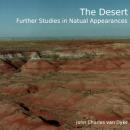
The Desert, Further Studies in Natural Appearances
"The Desert by John Charles Van Dyke, published in 1901, is a lush, poetic description of the natural beauty of the American Southwest. "What land can equal the desert with its wide plains, its grim mountains, and its expanding canopy of sky!" Van Dyke, a cultivated art historian, saw "sublimity" in the desert's "lonely desolation," which previous generations had perceived only as a wasteland, and his book has a conservationist flavor which seems distinctly modern. "The deserts should never be reclaimed," he writes. "They are the breathing spaces of the west and should be preserved for ever." The changing colors of the sky, hills, and sand impress Van Dyke, as do the mirages. He celebrates the "long overlooked commonplace things of nature"-- cactus and grease wood, desert animals, and "winged life," the birds and insects. His writing has a philosophical undertone. "Not in vain these wastes of sand ... simply because they are beautiful in themselves and good to look upon whether they be life or death." Anyone who views with equal awe fiery sunrises and weeds growing out of pavement cracks will enjoy this reading of Van Dyke's The Desert.(Summary by Sue Anderson)"
John Charles Van Dyke (Author), Sue Anderson (Narrator)
Audiobook
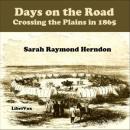
Days on the Road: Crossing the Plains in 1865
"“We had spent almost all our money for toll, ferrying and other expenses on the road. It might be a serious matter to be in a strange place without money . . . There is nothing we can spare so well as Dick. . . . It would not do to be sentimental under existing circumstances.” This is the practical pioneer woman Sarah Raymond Herndon writing in her journal about selling her horse to finance the final days of her family’s trek across the plains to Montana. However, when her brother, Hillhouse, actually sells her beloved pony, Sarah is distraught. “I sobbed out loud. I could not help crying. I let the purse (with the money) roll out of my lap into the bottom of the wagon.” But then, she stiffens her resolve and displays a quiet sense of humor: “Of course, I knew the wagon bed was tight, and there was no danger of (the purse) being lost.” Sarah became the first school teacher in Virginia City, Montana. Her account of crossing the plains in 1865 is rich in emotion and incident. Summary by Sue Anderson"
Sarah Raymond Herndon (Author), Sue Anderson (Narrator)
Audiobook
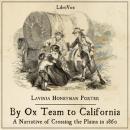
By Ox Team to California - A Narrative of Crossing the Plains in 1860
"Imagine a young, twenty-something woman in 1860, reared “in the indolent life of the ordinary Southern girl” (which means she has never learned to cook); married to a professional man who knows “nothing of manual labor;” who is mother to a young son; and who has just found out she is pregnant with their second child. Imagine that this couple has become “embarrassed financially” by “imprudent speculations,” and that they are discussing what to do. They decide to buy a wagon and three yoke of unbroken oxen and head overland to California. "We were two such precious dunces,” writes Lavinia Honeyman Porter in her autobiographical account of their journey across the plains. “In a short time the six oxen were bought, driven to our home and turned loose in our barnyard--wild brutes, as handy as with their heels as with their horns. Not one of us was brave enough to venture into the corral with them and we soon concluded we had six white elephants on our hands.” From there on in, Lavinia's adventures get worse—and then better. For those who enjoy true stories of pioneering days and happy endings, this is an enjoyable read. (Introduction by Sue Anderson)"
Lavinia Honeyman Porter (Author), Sue Anderson (Narrator)
Audiobook
Incidents of Travel in Central America, Chiapas, and Yucatán, Vol. 2
"The year is 1838. The scene is the dense Honduran forest along the Copán River. Two men, John Lloyd Stephens and Frederick Catherwood, are about to rediscover Mayan civilization. Their guide, slashing through the rampant growth with his machete, leads them to a stone column, fourteen feet high, sculptured on the front with a portrait of a man, "solemn, stern and well fitted to excite terror," covered on the sides with hieroglyphics, and with workmanship "equal to the finest monuments of the Egyptians." Stephens records their discoveries and also his travels in Central America, while Catherwood directs his immense artistic talent to illustrating views of Mayan architecture. Incidents of Travel in Central America, Chiapas and Yucatán was a best seller in its day and has been called an "Indiana Jones" saga by modern reviewers. (Summary by Sue Anderson)"
John Lloyd Stephens (Author), Sue Anderson (Narrator)
Audiobook
Incidents of Travel in Central America, Chiapas, and Yucatan, Vol. 1
"The year is 1838. The scene is the dense Honduran forest along the Copán River. Two men, John Lloyd Stephens and Frederick Catherwood, are about to rediscover Mayan civilization. Their guide, slashing through the rampant growth with his machete, leads them to a structure with steps up the side, shaped like a pyramid. Next they see a stone column, fourteen feet high, sculptured on the front with a portrait of a man, "solemn, stern and well fitted to excite terror," covered on the sides with hieroglyphics, and with workmanship "equal to the finest monuments of the Egyptians." Stephens records these discoveries and also his travels in Central America, where he had been sent by President Van Buren as special ambassador to the ill-fated Republic of Central America. The republic being engulfed in civil war when Stephens arrives in Guatemala, he finds himself dodging revolutionary armies while he hunts for a "legitimate government" to which to present his credentials. Catherwood, meanwhile, directs his immense artistic talent to illustrating views of Mayan architecture. Incidents of Travel in Central America, Chiapas and Yucatan was a best seller in its day and has been called an "Indiana Jones" saga by modern reviewers. (Summary by Sue Anderson)"
John Lloyd Stephens (Author), Sue Anderson (Narrator)
Audiobook
""Early in the summer of 1860, I had an attack of gold fever. In Chicago, the conditions for such a malady were all favorable. Since the panic of 1857 there had been three years of general depression, money was scarce, there was little activity in business, the outlook was discouraging, and I, like hundreds of others, felt blue." Thus Chalkley J. Hambleton begins his pithy and engrossing tale of participation in the Pike's Peak gold rush. Four men in partnership hauled 24 tons of mining equipment by ox cart across the Great Plains from St. Joseph, Missouri, to Denver, Colorado. Hambleton vividly recounts their encounters with buffalo herds, Indians, and"the returning army of disappointed gold seekers." Setting up camp near Mountain City, Colorado, Hambleton watched one man wash "several nice nuggets of shining gold" from the dirt and gravel, only to learn afterwards that "these same nuggets had been washed out several times before, whenever a 'tenderfoot' would come along, who it was thought might want to buy a rich claim." Two years later, "tired and disgusted with the whole business," Hambleton returned to Chicago, where he arrived "a wiser if not richer man." In later years, Hambleton was a prominent Chicago lawyer, real estate developer, and a member of the Chicago Board of Education. He wrote this candid account for family and friends, publishing it privately in 1898. It is based in good part on letters he had sent from the gold fields to his sister. Summing up his experience with wry humor, he writes: "After selling out my interest in the joint enterprise, I still had left some fifty claims on various lodes . . . Some time after returning to Chicago, I was making a real estate trade . . . and I threw in these fifty gold mines. . . Had I only kept them, and gotten up some artistic deeds of conveyance, in gilded letters, what magnificent wedding presents they would have made. . . In the long list of high-sounding, useless presents, the present of a gold mine would have led all the rest." (Summary by Sue Anderson)"
Chalkley J. Hambleton (Author), Sue Anderson (Narrator)
Audiobook
Army Letters from an Officer's Wife, 1871-1888
""There appeared from the bushes in front of me, and right in the path, two immense gray wolves . . . Rollo saw them and stopped instantly, giving deep sighs, preparing to snort, I knew . . . To give myself courage, I talked to the horse, slowly turning him around . . . when out of the bushes in front of us, there came a third wolf! The situation was not pleasant and without stopping to think, I said 'Rollo, we must run him down - now do your best' and taking a firm hold of the bridle, and bracing myself in the saddle, I struck the horse with my whip and gave an awful scream. . ." Thus, the spunky and resourceful Frances Roe recounts one of her many adventures. Frances was the young wife of a West Point Army officer, whose career took them both to frontier garrisons in what are now the states of Kansas, Colorado, Oklahoma, Utah, Montana, and Wyoming. Her letters home to her family in upstate New York, written between 1871 and 1888, and published in book form in 1909, are a fascinating chronicle of life on the frontier. Despite the grittiness of keeping house in tent-and-log-cabin quarters, Frances took to Western life, learning to shoot and ride (side saddle), fly fish for trout and hunt buffalo. Her letters, chatty and detailed, open windows on varied aspects of frontier and army life: army protocol (including the right of senior officers to bump subordinates out of their housing ); the Indian tribes--Arapahoe, Cheyenne, Apache, Kiowa (ceremonial visits from chiefs as well as Indian warfare); the black cavalry troops (at Camp Supply in Indian Territory); Chinese cooks (also Polish, Irish, and enlisted men doing kitchen duty). Her letters span years of rapid change in the West. They touch on the disappearance of the buffalo herds, the decline of the Indian tribes and the coming of the railroads. Even Yellowstone Park, established in 1872, gets a mention: "Now that the park can be reached by railroad, all of the generals, congressmen, and judges are seized with a desire to inspect it--in other words, it gives them a fine excuse for an outing at Uncle Sam's expense." Her emotions run deep when she writes: "I love army life here in the West, and I love all the things that it brings to me--the grand mountains, the plains, and the fine hunting." But, Frances' husband, Fayette Washington Roe, is eventually promoted to a headquarters desk job. Frances tries to evinse enthusiasm for town life: "since I cannot return to the plains, I might as well go to the city, where we will meet people of culture." But even shopping for the necessary clothes distresses her: "Parasols have bothered me. I would forget to open them in the street, and would invariably leave them in the stores when shopping and then have to go about looking them up." She then utters a timeless cry of urban angst: "It is the feeling of loneliness I mind here--of being lost and no one to search for me." (written at a hotel in Omaha, Nebraska in August 1888) Anyone with nostalgia for or curiosity about the Old American West will certainly enjoy this book. (Summary by Sue Anderson)"
Frances M. A. Roe (Author), Sue Anderson (Narrator)
Audiobook
"Major John Graham Gillam, British Supply Officer, wrote in his World War I Gallipoli Diary that when he sailed from England for the Dardanelles in March, 1915, he had visions of "trekking up the Gallipoli Peninsula with the Navy bombarding a way for us up the Straits and along the coast-line of the Sea of Marmora, until after a brief campaign we entered triumphantly Constantinople, there to meet the Russian Army, which would link up with ourselves to form part of a great chain encircling and throttling the Central Empires. . . We little appreciated the difficulties of the task," he continues, in potent understatement. Gillam's charge was shepherding supplies--food and munitions--from beach depots to the trenches for a brigade of 4000 men. Since it was his first experience with "real war," he decided to keep a diary, which he did from the day he landed at Gallipoli (April 25, 1915) until he was evacuated at the end of the campaign in January 1916. He aptly states in the preface to the published Version of his diary: "those who desire to survey the whole amazing Gallipoli campaign in perspective must look elsewhere than in these pages. Their sole object was to record the personal impressions, feeling, and doings from day to day of one supply officer to a Division whose gallantry in that campaign well earned for it the epithet "Immortal." As the campaign intensifies, Gillam's entries mature. Early on (May 30), a sample entry: "This afternoon I ride . . . to Morto Bay, and on the way have a delightful cross-country canter. I have difficulty, though, in making my mare jump trenches. She jumped hurdles at Warwick race-course like a bird." A month later, on June 30, "The smell of dead bodies is at times almost unbearable in the trenches, and chloride of lime is thrown over them. I know of no more sickly smell than chloride of lime with the smell of a dead body blended in." Another month, and respect for the Turks, and also for the rugged terrain of the peninsula is evident (August 29): "Behind me, purple Turkish hills, every point of which is held by the enemy. Then in between our line and the hills the scrubby low-lying country. . . I look at it hopelessly--for I know now, as we all do, that the conquest of the Peninsula is more than we can hope for. All that is left to us is to hang on day by day. . . Death in various forms walks with us always . . ." Today, the Turkish Government maintains a war memorial and cemeteries at the Gallipoli Peninsula Historical National Park. Memories are very much alive there. Preserved trenches and the sad graves of many, many soldiers from both sides of the conflict are made especially poignant by the beauty of the setting-- the sea and high hills beyond. (Summary by Sue Anderson)"
John Graham Gillam (Author), Sue Anderson (Narrator)
Audiobook

Story of a Common Soldier of Army Life in the Civil War, 1861-1865, The
"Leander Stillwell was an 18-year-old Illinois farm boy, living with his family in a log cabin, when the U.S. Civil War broke out. Stillwell felt a duty "to help save the Nation;" but, as with many other young men, his Patriotism was tinged with bravura: "the idea of staying at home and turning over senseless clods on the farm with the cannon thundering so close at hand . . . was simply intolerable." Stillwell volunteered for the 61st Illinois Infantry in January 1861. His youthful enthusiasm for the soldier's life was soon tempered at Shiloh, where he first "saw a gun fired in anger," and "saw a man die a violent death." Stillwell's recounting of events is always vivid, personal, and engrossing. "I distinctly remember my first shot at Shiloh . . . The fronts of both lines were . . . shrouded in smoke. I had my gun at a ready, and was trying to peer under the smoke in order to get a sight of our enemies. Suddenly I heard someone in a highly excited tone calling to me from just in my rear, --'Stillwell! Shoot! Shoot! Why don't you shoot?' I looked around and saw that this command was being given by . . . our second lieutenant, who was wild with excitement, jumping up and down like a hen on a hot griddle. 'Why, lieutenant,' I said, 'I can't see anything to shoot at.' 'Shoot, shoot, anyhow!' 'All right,' I responded. . . And bringing my gun to my shoulder, I aimed low in the direction of the enemy, and blazed away through the smoke. But at the time the idea to me was ridiculous that one should blindly shoot into a cloud of smoke without having a bead on the object to be shot at." The Story of a Common Soldier is a compelling coming of age tale that will appeal not only to Civil War buffs but to anyone who enjoys autobiographies. Written at the urging of his youngest son, when Stillwell was a mature man--a lawyer, judge, and member of the Kansas legislature, it combines graphic detail (provided by his war diary and letters written at the time to his family) with the insights of a thoughtful man looking back on those horrific times.(Summary by Sue Anderson)"
Leander Stillwell (Author), Sue Anderson (Narrator)
Audiobook

©PTC International Ltd T/A LoveReading is registered in England. Company number: 10193437. VAT number: 270 4538 09. Registered address: 157 Shooters Hill, London, SE18 3HP.
Terms & Conditions | Privacy Policy | Disclaimer
Join our community for the latest bookish news, reading recommendations, exclusive opening extracts, author events and competitions. It\'s all free. And enter a monthly draw to win a £50 Gift Card. See past winners here
Join Our Community