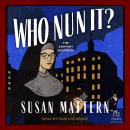
"In a 1960s convent, Kristen, a first-year nun, and her teacher, Sister Inez, stumble over a dead body in the basement of the motherhouse late one night. The woman is dressed like a nun, but no one knows her. The police are called and begin their investigation, but Sister Inez, ever the busybody, insists that she and Kristen will solve the murder. Complicating everything is Kristen's attraction to the young detective assigned to the case. Their investigation is harmless enough until Kristen gets a threatening letter from the murderer telling her to stop, and she begins to worry for her life. Was it another nun in the motherhouse who committed the crime? Will they solve the murder? Will her infatuation for the detective ruin her vocation? Kristen will solve three cases in this first book of the Who Nun It? Mystery Series."
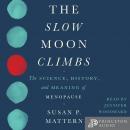
"This audiobook narrated by Jennifer Woodward provides the first comprehensive account of menopause from prehistory to today
Are the ways we look at menopause all wrong? Historian Susan Mattern says yes, and The Slow Moon Climbs reveals just how wrong we have been. Taking readers from the rainforests of Paraguay to the streets of Tokyo, Mattern draws on historical, scientific, and cultural research to reveal how our perceptions of menopause developed from prehistory to today. For most of human history, people had no word for menopause and did not view it as a medical condition. Rather, in traditional foraging and agrarian societies, it was a transition to another important life stage. This book, then, introduces new ways of understanding life beyond fertility.
Mattern examines the fascinating 'Grandmother Hypothesis'—which argues for the importance of elders in the rearing of future generations—as well as other evolutionary theories that have generated surprising insights about menopause and the place of older people in society. She looks at agricultural communities where households relied on postreproductive women for the family's survival. And she explores the emergence of menopause as a medical condition in the Western world. It was only around 1700 that people began to see menopause as a dangerous pathological disorder linked to upsetting symptoms that rendered women weak and vulnerable. Mattern argues that menopause was another syndrome, like hysterical suffocation or melancholia, that emerged or reemerged in early modern Europe in tandem with the rise of a professional medical class.
The Slow Moon Climbs casts menopause, at last, in the positive light it deserves—not only as an essential life stage, but also as a key factor in the history of human flourishing."
Join our community for the latest bookish news, reading recommendations, exclusive opening extracts, author events and competitions. It\'s all free. And enter a monthly draw to win a £50 Gift Card. See past winners here