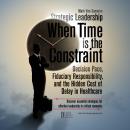
"Most healthcare organizations aren't failing. They're underperforming — held back by governance structures that were never designed to force decisions to resolution before time makes them instead.
Strategic Leadership When Time Is the Constraint follows Horizon Valley Health System as it confronts steadily declining margins, workforce pressures, and the compounding cost of decisions that are understood but never made. Into this environment comes Bill Ellis, a retired strategist called back by the inimitable Sister Margaret Albrecht to chair a board that is capable of oversight but structurally incapable of enforcement.
Working alongside CEO Hannah Wells and her leadership team, Bill introduces a governance framework built around four practical tools: Decision Windows that make time visible and urgent, the Mission-Margin Map that forces tradeoffs into the open, explicit decision rights that replace consensus with accountability, and a Red Flag mechanism that protects early, incomplete signals before they arrive too late to matter.
The book's central argument is both structural and urgent: decision pace is capacity. The accumulation of unresolved decisions consumes management bandwidth, analytical resources, and leadership attention that could be going somewhere else. At one-fifth of U.S. GDP — with health insurance becoming unaffordable for the families these systems exist to serve — slow governance is no longer just an internal management problem. It is a structural contributor to a cost trajectory that society can no longer sustain.
Strategic Leadership When Time Is the Constraint is the third book in the Strategic Leadership Series and the most operationally specific. It was written for health system executives, board members, governance professionals, and the advisors who serve them — anyone who recognizes the pattern and wants a practical framework to change it."
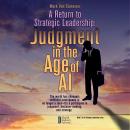
"Leadership has always required judgment.
What has changed is the environment in which judgment is exercised.
Artificial intelligence now shapes how information is produced, filtered, and presented to leaders. It accelerates analysis and offers recommendations with increasing confidence. In many organizations, decisions appear to emerge naturally from systems and models—leaving less visible space for deliberation, responsibility, and human judgment.
A Return to Strategic Leadership: Judgment in the Age of AI explores what happens when optimization begins to replace accountability.
Structured as a business novel, the book follows a senior executive facing a series of consequential decisions where data and algorithms point in one direction, while experience, context, and ethical responsibility suggest another. The narrative reflects tensions familiar to experienced leaders: speed versus reflection, insight versus ownership, and intelligence versus wisdom.
The argument is not anti-technology. It is pro-leadership. AI can inform decisions, but it cannot assume responsibility for them. When stakes are high and trade-offs are real, judgment remains irreducibly human.
Written for executives, board members, and senior leaders, this book is a reflection on what leadership demands in an age that promises certainty—but cannot deliver accountability."
Join our community for the latest bookish news, reading recommendations, exclusive opening extracts, author events and competitions. It\'s all free. And enter a monthly draw to win a £50 Gift Card. See past winners here