Browse audiobooks by Bill Yenne, listen to samples and when you're ready head over to Audiobooks.com where you can get 3 FREE audiobooks on us
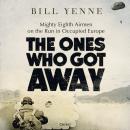
The Ones Who Got Away: Mighty Eighth Airmen on the Run in Occupied Europe
"Bloomsbury presents The Ones Who Got Away by Bill Yenne, read by Christopher Ragland. A remarkable collection of accounts of intrepid American aircrew shot down over enemy lines during World War II and how they got away. To be an airman in the Eighth Air Force flying over the war-torn skies of Europe required skill, tenacity, and luck. Those who were shot down and evaded capture needed all of that and more if they were to make it back to friendly lines. These are their stories. Each is compiled from the original intelligence debrief written by the pilots or aircrew themselves. Bill Yenne details how a spider web of escape routes sprang up, created by the local Résistance. Downed airmen were clothed, given false papers, and hidden so they could be smuggled back to England. These efforts were then supplemented by Allied intelligence agents. But the risks remained the same. Capture could mean death. Their accounts are sometimes funny, often heartbreaking. P-47 pilot Joel McPherson feigned appendicitis and was able to escape from the local German military hospital – after he had his appendix removed. He spent weeks operating as a getaway driver for a Maquis bank robber gang before making it into neutral Spain. Bomber crewmen Fred Hartung and Norman Therrien found refuge at a French château, but later nearly froze to death crossing the icy Pyrenees with the Gestapo on their trail. The accounts of these men and others from the Mighty Eighth make this a story of defiance, foolhardiness, and bravery against the odds."
Bill Yenne (Author), Christopher Ragland (Narrator)
Audiobook
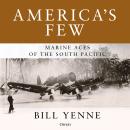
America's Few: Marine Aces of the South Pacific
"Bloomsbury presents America's Few by Bill Yenne, read by Geoff Sugiyama. America's Few delves into the history of US Marine Corps aviation in World War II, following the feats of the Corps’ top-scoring aces in the skies over Guadalcanal. Marine Corps aviation began in 1915, functioning as a self-contained expeditionary force. During the interwar period, the support of USMC amphibious operations became a key element of Marine aviation doctrine, and the small force gradually grew. But in December 1941 came the rude awakening. Within hours of Pearl Harbor, heroic Marine aviators were battling the Japanese over Wake Island. In the South Pacific, the aviators of the US Marine Corps came out of the shadows to establish themselves as an air force second to none. In the summer of 1942, when Allied airpower was cobbled together into a single unified entity – nicknamed 'the Cactus Air Force’ – Marine Aviation dominated, and a Marine, Major General Roy Geiger, was its commander. Of the twelve Allied fighter squadrons that were part of the Cactus Air Force, eight were USMC squadrons. It was over Guadalcanal that Joe Foss emerged as a symbol of Marine aviation. As commander of VMF-121, he organized a group of fighter pilots that downed 72 enemy aircraft; Foss himself reached a score of 26. Pappy Boyington, meanwhile, had become a Marine aviator in 1935. Best known as the commander of VMF-214, he came into his own in late 1943 and eventually matched Foss’s aerial victory score. Through the parallel stories of these two top-scoring fighter aces, as well as many other Marine aces, such as Ken Walsh (21 victories), Don Aldrich (20), John L. Smith (19), Wilbur Thomas (18.5), and Marion Carl (18.5), many of whom received the Medal of Honor, acclaimed aviation historian Bill Yenne examines the development of US Marine Corps aviation in the South Pacific. P 2022 Bloomsbury Publishing PLC C 2022 Bill Yenne"
Bill Yenne (Author), Geoff Sugiyama (Narrator)
Audiobook
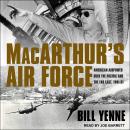
MacArthur’s Air Force: American Airpower Over the Pacific and the Far East, 1941-51
"General Douglas MacArthur is one of the towering figures of World War II, and indeed of the twentieth century, but his leadership of the second largest air force in the USAAF is often overlooked. When World War II ended, the three numbered air forces (the Fifth, Thirteenth and Seventh) under his command possessed 4,004 combat aircraft, 433 reconnaissance aircraft and 922 transports. After being humbled by the Japanese in the Philippines in 1942, MacArthur and his air chief General George Kenney rebuilt the U.S. aerial presence in the Pacific, helping Allied naval and ground forces to push back the Japanese Air Force, re-take the Philippines, and carry the war north towards the Home Islands. Following the end of World War II MacArthur was the highest military and political authority in Japan, and at the outbreak of the Korean War in June 1950 he was named as Commander in Chief, United Nations Command. In the ten months of his command his Far East Air Forces increased dramatically and saw the first aerial combat between jet fighters. Written by award-winning aviation historian Bill Yenne, this engrossing book traces the journey of American air forces in the Pacific under General MacArthur's command, from their lowly beginnings to their eventual triumph over Imperial Japan, followed by their entry into the jet age in the skies over Korea."
Bill Yenne (Author), Joe Barrett (Narrator)
Audiobook
©PTC International Ltd T/A LoveReading is registered in England. Company number: 10193437. VAT number: 270 4538 09. Registered address: 157 Shooters Hill, London, SE18 3HP.
Terms & Conditions | Privacy Policy | Disclaimer
Join our community for the latest bookish news, reading recommendations, exclusive opening extracts, author events and competitions. It\'s all free. And enter a monthly draw to win a £50 Gift Card. See past winners here
Join Our Community